
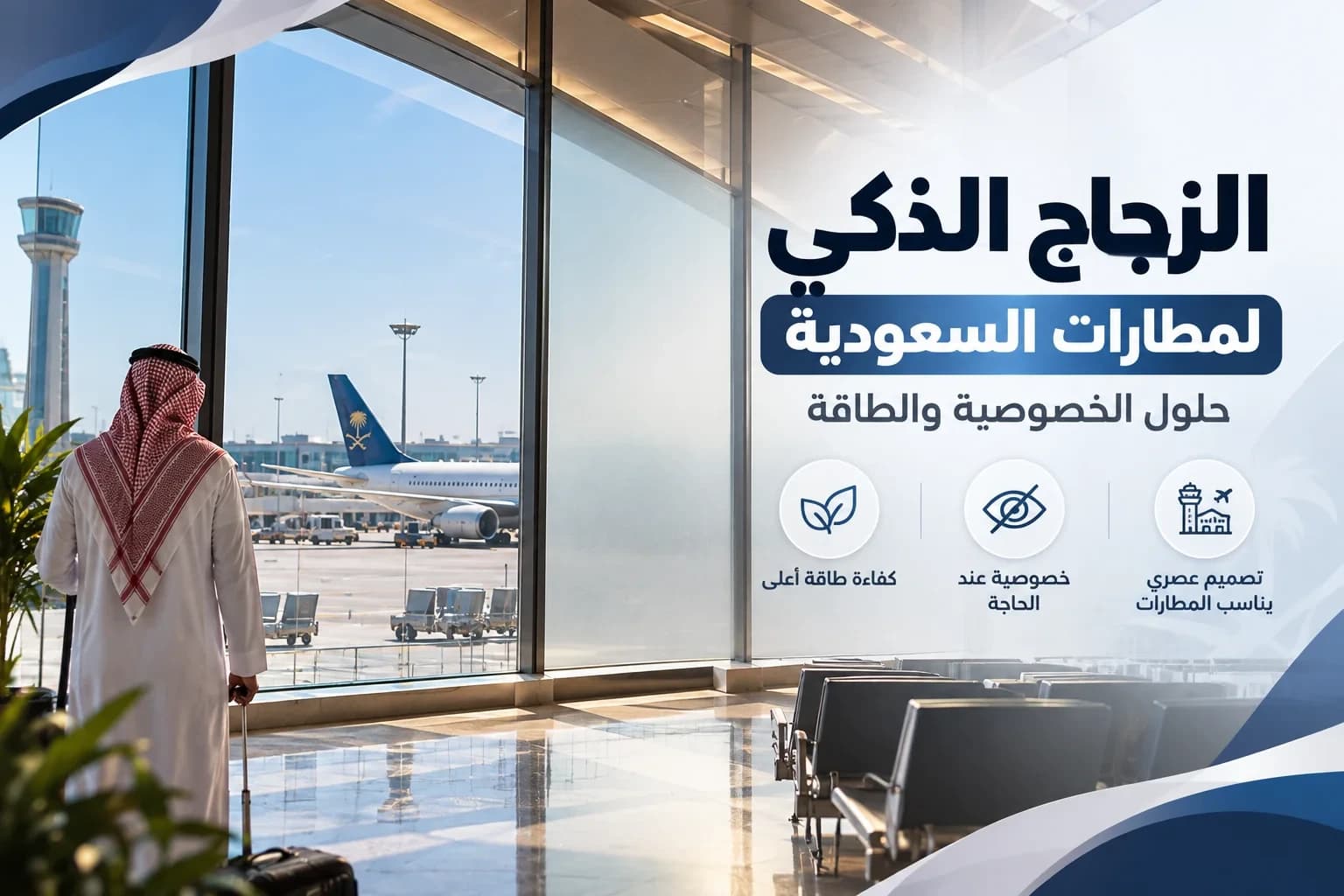
The airport sector continues to evolve in terms of building design and passenger experience, with growing attention to visual comfort, energy efficiency, and flexible spaces that meet different operational needs. This highlights the importance of smart glass for Saudi airports as a technological solution that can be used in administrative offices, VIP lounges, meeting rooms, and selected glass-enclosed spaces within airport buildings.
The function of smart glass varies depending on the technology used. Some types allow users to control privacy at the touch of a button, while others regulate solar light transmission and help reduce glare and heat. Choosing the right solution therefore requires an understanding of each space's characteristics and the project's objectives before determining the appropriate technology.
What Is Smart Glass for Saudi Airports?
Smart glass is a broad term that encompasses advanced glazing technologies designed to change certain glass properties, such as transparency, tint level, or the amount of light and heat transmitted, depending on the technology used. These solutions are particularly important in airports because of the variety of spaces and the different privacy and lighting requirements within them.
One of the main technologies in this field is PDLC smart privacy film, which can be installed on existing glass or integrated between glass layers during manufacturing. When electricity is switched on, the film becomes relatively transparent. When the power is switched off, it changes to an opaque, white appearance that limits direct visibility. Other technologies, such as electrochromic glass, adjust the glass tint to control sunlight and glare. Distinguishing between these technologies is essential when designing smart glass solutions for airports.
The Importance of Smart Glass in the Development of Saudi Airports
Modern airports need to balance architectural design, comfort, and efficient space management. Smart glass can help address these needs when the appropriate technology is selected and applied in suitable locations.
Its potential benefits include:
Improving privacy in spaces used for meetings and sensitive conversations.
Helping reduce solar glare when using dynamic glass designed to regulate light.
Providing greater flexibility in interior partition design instead of relying permanently on opaque barriers.
Supporting modern architectural designs that make use of natural light while maintaining an open appearance.
Actual results depend on the technology, glass specifications, façade orientation, and operating conditions. Each project should therefore undergo an engineering assessment rather than assuming that all types of smart glass offer the same properties.
Main Applications of Smart Glass in Airports
Smart glass has various applications in airports depending on the nature of each space, operational requirements, and security considerations. It can be used in several areas within airport facilities.
Smart Glass for VIP Lounges
VIP lounges need to combine a premium design with privacy when required. Smart privacy film can be used on selected glass partitions to transform an open space into a more private environment during meetings or confidential consultations, while allowing transparency to be restored when the space is no longer in use.
Smart Glass for Meeting Rooms and Administrative Offices
Smart film can be installed on the glass walls of meeting rooms and administrative offices, creating a more private environment when discussing sensitive information. The space can then return to its open appearance after the meeting.
Service Areas
Smart privacy film may be suitable for certain administrative rooms, consultation spaces, and service areas where visibility needs to be controlled. Its use in security-sensitive or operational areas must be assessed by qualified specialists and must not obstruct essential sightlines required for monitoring or safety.
What Is the Difference Between Smart Film and Smart Glass for Heat Control?
Although the term smart glass is used to describe several technologies, their operating mechanisms and results differ. Understanding these differences helps identify the right solution for the needs of Saudi airports.
PDLC Smart Privacy Film
This film is primarily used to control visibility by switching between transparent and opaque modes. One of its main advantages is that it can be applied to many existing glass surfaces after confirming their suitability, potentially reducing the need to replace the entire glass panel.
It is suitable for interior partitions, meeting rooms, and selected spaces that require flexible privacy.
Dynamic Glass for Solar Light Control
Technologies such as electrochromic glass adjust the glass tint to control sunlight and glare. Depending on the system specifications and building conditions, they may also help reduce thermal loads associated with solar radiation. This category is particularly relevant to windows and sun-exposed façades.
It is important not to consider PDLC film a direct replacement for every thermal-control solution. The appropriate technology depends on the project's primary objective.
How Does Smart Glass Contribute to Energy Efficiency in Airports?
Managing energy consumption is an important consideration in large buildings that operate for extended hours, including airports. Dynamic glazing technologies designed to control solar radiation can help reduce glare and certain thermal loads, potentially lowering cooling requirements under specific conditions.
Achieving these benefits requires an assessment of façade orientation, glass type, sun-exposed areas, and HVAC system characteristics. The solar heat gain coefficient and visible light transmittance should also be evaluated using the manufacturer's data rather than relying on general promises of a fixed percentage of electricity savings.
Smart privacy film, on the other hand, is primarily designed to control visibility. It should not be assumed to provide high thermal insulation simply because it turns white when activated. An integrated approach to façade design, insulation, and shading remains essential for achieving suitable energy performance.
Criteria for Selecting Smart Glass for Airport Projects
Before specifying smart glass for Saudi airports, it is important to identify the operational and technical requirements of each area, particularly in projects that combine public spaces with administrative and service areas.
The main selection criteria include:
Defining the objective: Is the primary requirement instant privacy, heat and glare control, or a combination of both?
Compatibility with existing glass: Confirming that the surface is suitable for installation, assessing the glass condition, and checking compatibility with site conditions.
Electrical and control requirements: Evaluating power supply points, operating methods, and the possibility of integrating the system with building systems when necessary.
Safety requirements: Verifying applicable fire safety, electrical, and glazing requirements for the relevant areas and obtaining the project approvals required.
Maintenance and warranty: Reviewing operating, cleaning, and warranty conditions, as well as the availability of technical support and spare parts.
A technical inspection helps establish the project scope, cost, and schedule more accurately instead of selecting a product based on appearance alone.
Smart Glass in Airports as Part of Saudi Arabia's Development Initiatives
Modern airport projects require solutions that accommodate the local climate, continuous operating requirements, and passenger expectations for comfort and design quality. Smart glass can be part of this development approach when incorporated into an integrated engineering plan that considers building efficiency and safety.
The first step is to divide the project into clearly defined areas: façades that require solar light management, interior partitions that need privacy, and operational spaces where continuous visibility is essential. The appropriate technology can then be selected for each area instead of using a single product for every application.
It is also important to work with experienced installation specialists and review technical specifications and required approvals before procurement and installation begin. This approach helps maximize the practical benefits of smart technologies while maintaining operational requirements and reliability within airports.
Start Your Project with SmartVue Smart Glass Solutions
If you are developing an administrative office, meeting room, or private lounge as part of an aviation-related project, identifying the space's requirements is the first step toward selecting a suitable solution. SmartVue provides smart film solutions, including PDLC smart privacy film, and can assess existing glass to determine its suitability for installation based on the project's requirements.
The SmartVue team can help evaluate glass partitions, identify privacy requirements, assess control and electrical wiring needs, and develop a technical proposal tailored to the intended space. Since airport projects are subject to specific requirements, the relevant owner and consultant requirements must be verified before a solution is approved or implemented.
Contact SmartVue through its official website at smartvue.co to discuss your project requirements and request a technical inspection of suitable areas.
Frequently Asked Questions About Smart Glass for Saudi Airports
What Are the Applications of Smart Glass in Airports?
Depending on the technology, smart glass can be used in VIP lounges, meeting rooms, administrative offices, and selected windows and façades that require light and glare control. Each application should be determined according to privacy, safety, and operational requirements.
Can Smart Film Be Installed on Existing Glass?
Yes, smart privacy film can be installed on many types of existing glass, provided that the glass condition is assessed and its compatibility with the product and installation method is confirmed. A technical inspection helps determine its suitability.
Does Smart Glass Reduce Solar Heat Inside Airports?
This depends on the technology used. Dynamic glass designed to control solar radiation can reduce glare and certain thermal loads, whereas PDLC technology primarily focuses on changing visual privacy levels.
Does Smart Privacy Film Require Electricity?
Yes, PDLC film requires an electrical supply to switch to its transparent state. When the power is disconnected, it typically changes to an opaque, white appearance, depending on the product's design and specifications.
How Can the Cost of Smart Glass for Airports Be Determined?
The cost depends on the technology, glass area, surface condition, electrical and control work, and safety and installation requirements. An appropriate estimate therefore requires defining the project scope and conducting a technical inspection before a quotation is prepared.