
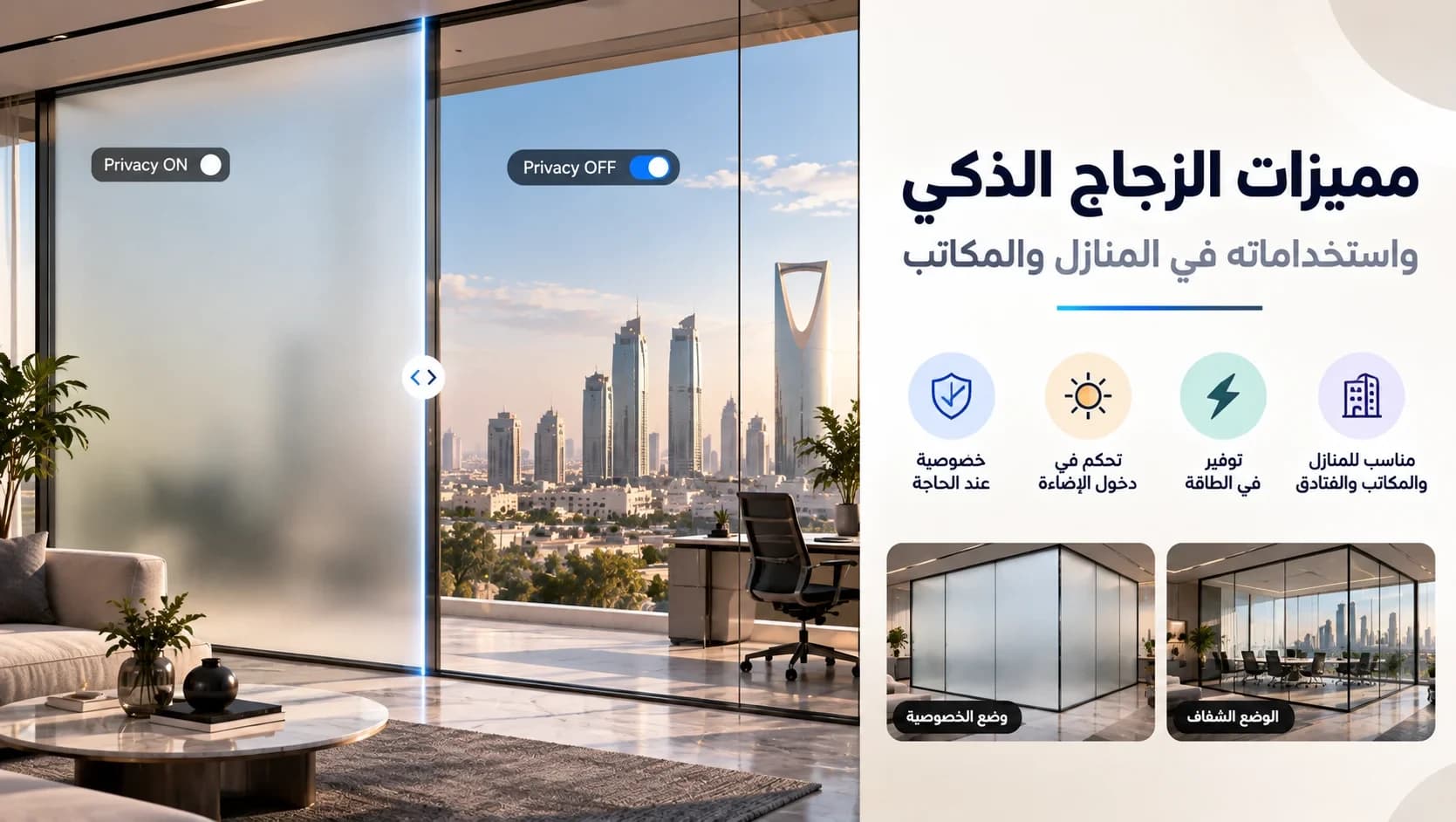
The features of smart glass have become an important topic in modern architectural design, particularly as the need for privacy and flexibility in residential and commercial spaces continues to grow. This technology makes it possible to change the optical properties of glass depending on the system used, allowing greater control over visibility while making more flexible use of natural light. In Saudi Arabia, these solutions are particularly relevant to luxury villas, executive offices, hotels, and clinics, where contemporary design must be balanced with privacy requirements. SmartVue offers PDLC smart film solutions that allow glass to switch from transparent to opaque at the touch of a button, without replacing the existing glass in suitable applications.
What Is Smart Glass and How Does It Work?
Smart glass is glass or a glazing system that can change its optical properties in response to an electrical signal or other external stimuli, depending on the technology used. One of the most widely used privacy solutions is PDLC, which stands for Polymer Dispersed Liquid Crystal. This technology relies on liquid crystals whose alignment changes when an electrical voltage is applied. When the system is powered on, the crystals become more uniformly aligned, allowing light to pass through more clearly and making the glass appear transparent. When the power is switched off, light scatters within the layer, making the surface appear white and opaque while limiting direct visibility. This technology can be implemented using glass with an integrated layer or smart film applied to a suitable glass surface, depending on the project's requirements.
Smart Glass and Privacy Control
One of the main features of smart glass is its ability to switch between transparency and privacy whenever needed, without relying on curtains or traditional partitions at all times. This feature is useful in spaces where privacy requirements change throughout the day, such as meeting rooms, executive offices, clinics, and bathrooms with suitable glass designs. When an open view is desired, the system can be activated to make the glass transparent. Privacy mode can then be enabled when a meeting begins or a client arrives. This flexibility provides practical use of space while maintaining a modern appearance. However, it is important to note that PDLC in its opaque state scatters light rather than blocking it completely. Therefore, it is not a complete substitute for dedicated blackout systems in spaces that require total light blockage.
Benefits of Smart Glass in Homes and Offices
Smart glass gives designers and property owners more options for dividing spaces without relying on fixed walls in every area. In homes, it can be used in interior partitions, certain doors, and windows, allowing spaces to appear more open when needed while providing privacy at other times. In offices, it can be installed in meeting rooms, executive offices, and shared workspaces. These applications help combine an open-plan appearance with flexible space division while reducing the need for traditional curtains in suitable locations. Electrical control systems can also be integrated with certain smart home solutions, provided the components are compatible. Choosing the right type of glass and installation method remains essential to ensuring suitable performance based on the space and its intended use.
Can Smart Glass Help Save Energy?
Smart glass may contribute to improved energy efficiency, but the level of savings depends on the technology used, the glazing configuration, climatic conditions, and the building's orientation. With PDLC systems, the primary function is privacy control and light scattering. This does not automatically mean the system provides high thermal insulation. Other smart glazing technologies designed to control solar heat gain, such as certain electrochromic systems, may help reduce cooling loads depending on their specifications and operating conditions. In Saudi Arabia, where high temperatures persist for extended periods of the year, the thermal performance of the entire glazing system should be evaluated before installation. It is therefore advisable to review technical specifications related to solar energy transmission and thermal insulation rather than assuming that a product will deliver energy savings simply because it is described as smart glass.
The Difference Between Smart Glass and Smart Film
Smart glass and smart film share a common purpose: providing flexible control over privacy or optical properties. However, their installation methods differ. Integrated smart glass contains the technological layer within the glass structure itself and is generally manufactured according to specific requirements before installation. Smart film, on the other hand, can be applied to existing glass when the surface type and condition are suitable. This makes it a practical option for certain renovation projects that do not require complete panel replacement. Choosing between the two solutions depends on the condition of the existing glass, budget, intended application, and design requirements. It is therefore best to evaluate the project's needs before selecting a technology rather than assuming that one option is suitable for every application.
When Is Smart Film the Right Choice?
Smart film may be suitable for offices, villas, and clinics that want to add switchable privacy to existing glass partitions. SmartVue offers PDLC solutions that can be installed according to project dimensions and electrical connection requirements. However, smart film is not equally suitable for every type of glass or environment. The surface, installation conditions, and exposure to moisture must be assessed before installation. The product must also be suitable for its intended application, and its operating instructions, maintenance requirements, and warranty should be reviewed. A preliminary technical assessment helps determine whether installation is feasible and reduces the risk of problems caused by choosing a product that is incompatible with the glass or site conditions.
Applications of Smart Glass in Saudi Arabia
Smart glass has a wide range of applications in residential and commercial projects across Saudi Arabia, depending on privacy requirements, design preferences, and intended use. In villas, it can be installed in selected interior partitions to provide flexibility between shared and private spaces. In offices, it is suitable for meeting rooms and executive offices that require quick transitions between openness and privacy. It can also be used in clinics, hotels, and certain commercial spaces, provided that the safety and privacy requirements of each application are taken into account. SmartVue showcases completed projects involving offices, meeting rooms, and villas, demonstrating the range of possible applications for this technology. Before choosing a solution, it is important to identify the primary purpose of the installation, whether it is controlling visibility, enhancing the design, or meeting the operational requirements of the space.
How to Choose the Right Smart Glass for Your Project
Choosing the right system depends on the nature of the project and the desired outcome, not just its appearance. If the main objective is to provide instant privacy within an existing glass partition, PDLC smart film may be a suitable option after the glass has been assessed. However, if the goal is to control the amount of solar heat entering the building, smart glazing technologies should be compared based on their actual thermal performance specifications. Before making a decision, consider the type and condition of the existing glass, the required level of transparency and privacy, electrical connection and control requirements, and operating conditions, particularly in areas exposed to moisture. It is also important to review the written warranty and post-installation technical support services and request a technical assessment to identify the most suitable solution and determine installation requirements before starting the project.
Start Your Project with SmartVue
If you are planning to upgrade your home or office using smart glass technology, identifying your space's requirements in advance can help you choose the most suitable solution. SmartVue provides smart film and PDLC technology solutions for residential and commercial projects in Saudi Arabia, including site assessments, measurements, installation, and user training. You can contact the company's team to discuss the condition of your existing glass, the required level of privacy, and the control options suitable for your project. It is important to request a technical proposal outlining product specifications, electrical requirements, warranty terms, and any installation limitations so that you can make a decision based on your actual needs. Careful planning helps achieve the right balance between design, functionality, and expected costs.
Frequently Asked Questions About the Features of Smart Glass
What Are the Main Features of Smart Glass?
The main features include privacy control, switching between transparency and opacity in PDLC systems, maintaining a modern interior design, and reducing reliance on curtains in certain suitable applications.
Can Smart Film Be Installed on Existing Glass?
Yes, certain types of smart film can be installed on existing glass if the surface is suitable and in good enough condition. A technical assessment is recommended to determine installation requirements and electrical connections.
Does Smart Glass Block Sunlight and Heat?
This depends on the technology used and the product's specifications. PDLC technology is primarily designed for privacy control, so high thermal insulation should not be assumed without reviewing the technical data.
Does Smart Glass Require Electricity?
Switchable PDLC systems require an electrical power source to change their optical state. When the power is disconnected, conventional PDLC film typically becomes opaque. However, the system's specifications should be reviewed to confirm its behavior during a power outage.
Where Can Smart Film Be Used in Saudi Arabia?
Smart film can be used in suitable applications within villas, offices, meeting rooms, clinics, hotels, and commercial spaces, provided that the product is appropriate for the site's conditions and safety requirements.