
Smart glass has become one of the modern solutions that combine privacy with contemporary design, especially in offices, villas, hotels, and clinics. However, like any technology, it has some limitations that should be understood before deciding to install it. These limitations vary depending on the type of glass or film used, manufacturing quality, installation method, and the environment in which it will operate. Therefore, understanding the disadvantages of smart glass in advance can help you determine whether it suits your application or whether another solution would be more appropriate. With PDLC technology specifically, there are some considerations related to clarity, energy consumption, moisture, and operating lifespan.
Smart Glass Disadvantages to Know Before Installation
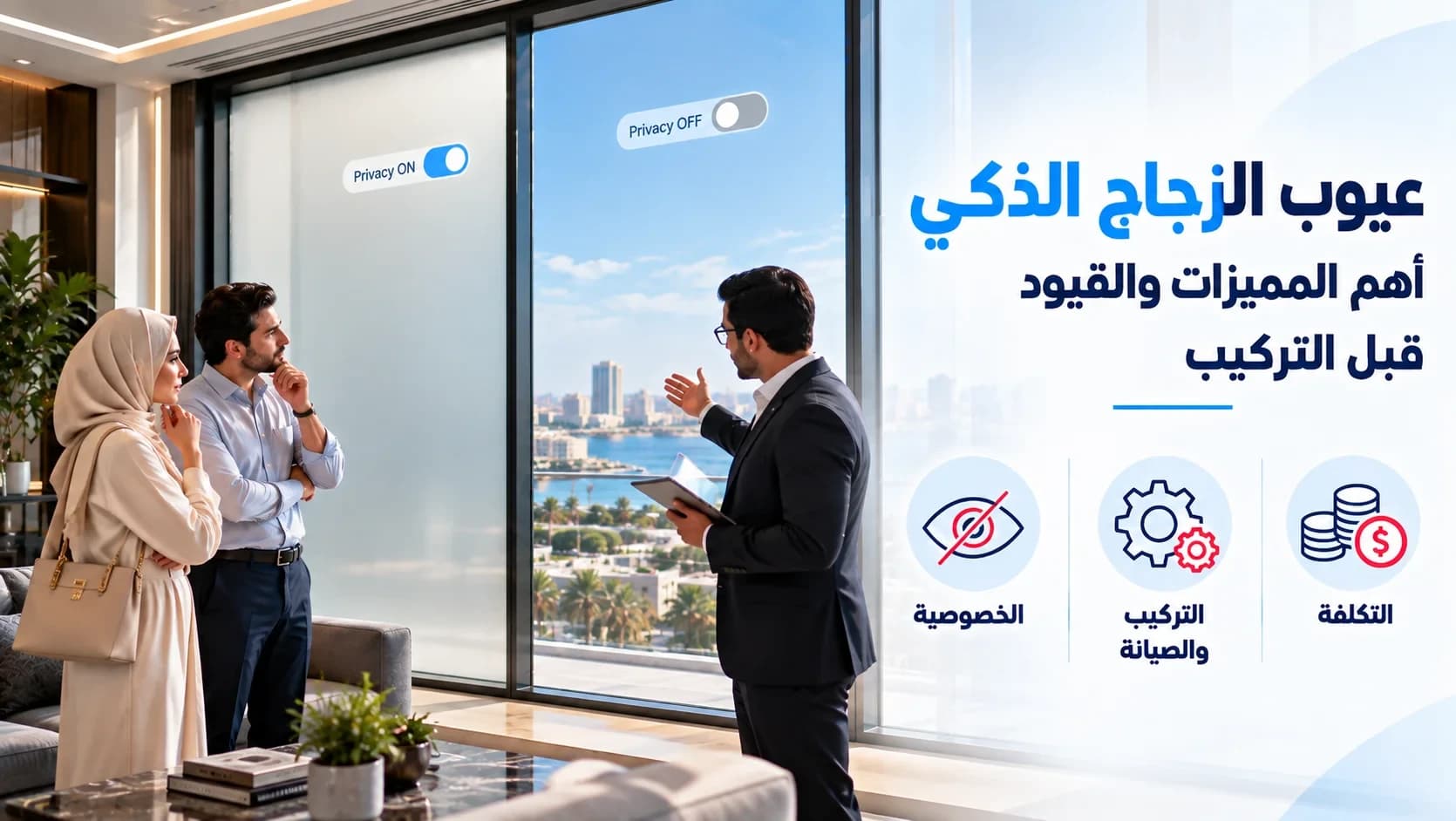
Although smart glass provides instant privacy at the touch of a button, the first disadvantage to consider is that switching to the opaque state does not necessarily mean blocking light completely. PDLC technology works by scattering light, so lighting and shadows may remain visible to varying degrees. This differs from blackout curtains or other Blackout systems.
Another important disadvantage of smart glass is that the quality of the experience depends heavily on the product and installation quality. With adhesive Smart Film, issues such as bubbles or edge separation may occur if the glass is not properly prepared or the film is not installed correctly. Some applications also require electrical wiring and a suitable transformer, which should be planned before installation rather than afterward.
PDLC Smart Glass Disadvantages and Their Impact on Visibility
PDLC technology uses liquid crystals to change the glass surface from transparent to opaque when electrical current is controlled. However, the transparent state is not always identical to conventional glass in terms of optical clarity. A slight degree of haze may appear depending on the film or glass specifications and its quality.
This becomes more noticeable when extremely clear visibility is a key requirement for the project, such as certain facades or spaces that require an unobstructed outdoor view. Therefore, it is not enough to simply ask whether the product is "transparent." It is better to check the light transmission rate and haze level in the technical specifications before installation. Technical studies indicate that balancing transparency and optical contrast is one of the known challenges of PDLC systems.
Does Smart Glass Completely Block Visibility?
The opaque mode does not mean that the glass turns into a black barrier that blocks 100% of light and visibility. It provides visual privacy by scattering light, but some shadows or shapes may remain noticeable depending on lighting conditions and viewing distance. Therefore, it is suitable for visual privacy but is not a direct substitute for Blackout solutions in spaces that require complete darkness.
Does Smart Glass Consume Electricity?
One of the important questions to consider before purchasing smart glass is whether it needs electricity continuously. The answer depends on how the system operates. In traditional PDLC systems, the film requires electrical power when it is in the transparent state, while it switches to the opaque state when the power is turned off. This means that continuous operation in the transparent mode results in electricity consumption, even if the consumption is relatively low compared with large electrical appliances.
On the other hand, a power outage does not necessarily mean losing privacy. In systems that switch to the opaque state when power is interrupted, privacy remains, but transparent visibility will not return until the power is restored. Therefore, the electrical system and transformer should be designed according to the glass area and intended use.
Smart Glass Lifespan and Factors That Affect It
The lifespan of smart glass is not a fixed figure for all products, as performance is affected by material quality, manufacturing, installation, temperature, humidity, and electrical system stability. With adhesive smart films in particular, the edges are sensitive areas, as moisture penetration or exposure of the connections to water can lead to reduced performance over time.
Operational issues may also occur, such as weaker switching between transparent and opaque states, uneven areas, or partial film separation. This becomes particularly important in bathrooms and humid areas, where a solution suitable for the environment should be selected, with proper attention to insulation and sealed edges.
Smart Film Disadvantages in Installation and Maintenance
One important point that some users overlook is that smart glass quality depends not only on the product itself but also on installation accuracy. Installing the film on an unclean surface or allowing dust and particles to remain between the glass and film can result in visible spots or bubbles after installation.
Electrical connections also require careful planning so that they are safe and do not negatively affect the final appearance. If an operating problem occurs, the cause could be the transformer, wiring, or the film itself. Therefore, inspection and maintenance should preferably be carried out by a specialized technician rather than attempting to handle the electrical system randomly.
Can Smart Film Be Installed on Any Glass?
Smart Film can be used as a solution for upgrading certain types of existing glass, but application suitability depends on the nature of the surface, its dimensions, the surrounding environment, and the installation method. Therefore, it is preferable to conduct a technical assessment before installation, especially in large spaces or areas that are continuously exposed to moisture and heat.
Is Smart Glass Suitable for Bathrooms and Humid Areas?
Smart privacy solutions can be used in bathrooms and certain humid applications, but choosing the appropriate technology and protection method is very important. Moisture and water can pose a risk to the film layers, connections, and edges if they are not properly protected.
In environments that are directly exposed to water or high humidity for extended periods, smart glass manufactured with an internal laminated structure may be more suitable than exposed adhesive film, as the PDLC layer is protected inside the glass assembly. Therefore, the product should not be selected based on appearance alone. The level of exposure to water and moisture, as well as the sealing and insulation method, should also be evaluated.
Smart Glass vs. Conventional Glass: Which Is Better?
The comparison between smart glass and conventional glass is not simply a matter of asking which type is "better." It depends on the requirements of the space. Conventional glass provides a simple solution and does not require an electrical system to control privacy, while smart glass adds the ability to change the level of privacy whenever needed.
If the primary goal is to achieve instant privacy while maintaining a modern glass appearance, PDLC technology may be suitable for offices, meeting rooms, villas, and certain commercial applications. However, if the requirement is specific sound insulation, complete blackout, or a solution that does not rely on electricity, other alternatives should be evaluated before making a decision.
Therefore, the disadvantages of smart glass do not mean that it is a poor choice. Instead, they highlight situations in which it may not be the most suitable solution.
When Is Smart Glass a Suitable Option Despite Its Disadvantages?
Smart glass is suitable when flexible privacy is an essential part of the space's requirements rather than simply a decorative addition. For example, a meeting room can remain open and transparent during the day and then become a private space when a meeting takes place. The same applies to certain offices, villas, clinics, and hotels.
However, the right decision begins by defining the required function: Do you need visual privacy only? Do you need Blackout? Is the space exposed to water? Is suitable electrical infrastructure available? Is outdoor visibility extremely important? Answering these questions helps determine the appropriate technology and specifications rather than relying solely on the product's promotional appearance.
How Do You Choose the Right Smart Glass?
Before making a purchase or signing a contract, review at least the following:
The type of glass or film technology used.
Light transmission rate and haze level in the transparent state.
Privacy level in the opaque state.
Electricity consumption and control method.
Product suitability for the humidity and temperature at the installation site.
Installation quality and product warranty.
Method used to seal the edges and electrical connections.
This approach allows you to evaluate the product based on your actual needs rather than appearance alone.
Get a Technical Consultation Before Installing Smart Glass
If you are considering installing Smart Film or smart glass in an office, villa, hotel, or clinic, it is best to start with a site assessment and determine the type of glass, surrounding environment, and intended use. SmartVue can assess the space and select a suitable solution based on the project's requirements, with attention to installation, electrical connections, and final operation. The goal is not simply to install a modern technology because it is modern, but to ensure that it provides the required privacy and suits the nature of the space over the long term.
Frequently Asked Questions About Smart Glass Disadvantages
Does Smart Glass Have Any Disadvantages?
Yes. Like any technology, it has certain limitations. The most notable include the fact that the opaque state does not necessarily provide complete Blackout, slight haze may occur in the transparent state, and some PDLC systems rely on electricity to maintain transparency. Performance can also be affected by installation quality and the surrounding environment.
Does Smart Glass Consume Electricity?
Yes. Traditional PDLC systems consume electricity when operating in the transparent state, while continuous power is not required to maintain the opaque state in systems that operate this way. Consumption varies depending on the system type, size, and specifications.
Does Smart Glass Completely Block Light?
No. PDLC smart glass scatters light and provides visual privacy, but it does not provide the same effect as a complete Blackout system. Lighting and shadows may remain visible to varying degrees depending on the product and lighting conditions.
Can Smart Film Be Installed on Existing Glass?
Yes. One of the key advantages of Smart Film is that it can be used as a retrofit solution on existing glass instead of replacing the entire panel, provided that the glass and surface are suitable for installation and the work is carried out by a specialized technician.
Is Smart Glass Suitable for Bathrooms?
It can be used in certain bathroom applications, but the product, installation method, and protection should be selected according to the level of exposure to water and moisture. In highly humid areas, internally laminated smart glass may be more suitable than exposed adhesive film.