
Modern educational institutions need environments that combine comfort, privacy, and flexibility in how spaces are used, particularly as architectural designs increasingly incorporate glass partitions and windows within schools. However, transparent glass may not be suitable at all times, especially during meetings or activities that require privacy for students and teachers.
This is where smart film for schools offers a practical solution. It allows users to control glass transparency at the touch of a button, without replacing the glass or relying on traditional curtains. In this article, we explore how smart film works, its main applications in educational facilities, its benefits and installation considerations, and how to choose the right solution for a school's needs.
What Is Smart Film for Schools and How Does It Work?
Smart film is an intelligent film installed on glass surfaces. It uses Polymer Dispersed Liquid Crystal technology, commonly known as PDLC. This technology allows the glass to switch from transparent to opaque through electrical control.
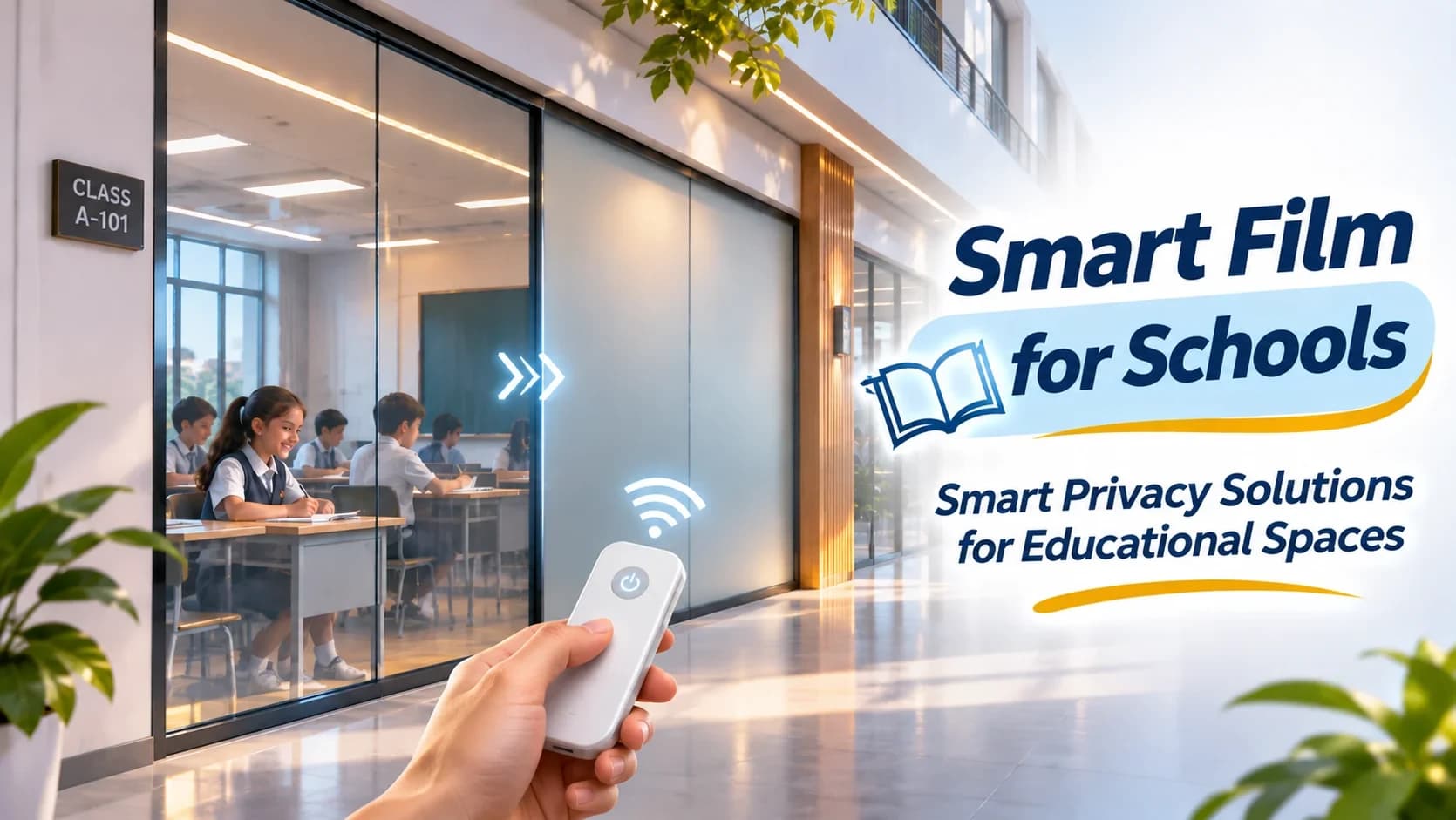
When the power is switched on, the liquid crystals align in a way that allows light to pass through more clearly, making the glass transparent. When the power is switched off, the crystals become randomly dispersed, giving the film a milky-white appearance. This creates a visual barrier that prevents direct visibility while still allowing some light to pass through.
This feature makes smart film suitable for schools that use glass partitions. It allows spaces to switch between an open layout and a private setting whenever needed, without requiring structural changes to the building's design.
Main Applications of Smart Film in Schools and Educational Institutions
Smart film applications vary depending on the type of space within an educational facility. It can be used in several areas:
1. Classrooms and Glass Partitions
Smart film can be installed on glass partitions between classrooms and corridors. The transparent setting allows natural light to enter and creates a greater sense of space, while the opaque setting provides visual privacy when needed.
It can also be used in multi-purpose classrooms that need to switch from an open learning environment to a space designated for activities or examinations.
2. School Administration Offices and Meeting Rooms
School principals' offices and teachers' meeting rooms require privacy during administrative discussions and meetings. Smart film allows glass walls to become opaque when needed and return to their transparent state once the meeting is over.
3. Laboratories and Activity Rooms
Some schools have science laboratories and training rooms with glass facades. Smart film can be used to control external visibility during experiments or activities that require fewer visual distractions.
However, it is important to remember that smart film does not replace safety requirements or protective barriers designed specifically for laboratories.
4. Student Counseling and Consultation Rooms
Student counseling and psychological or educational consultation rooms require an appropriate level of visual privacy. Smart film helps provide this privacy flexibly, while allowing the space to return to an open setting at other times.
Benefits of Installing Smart Film in Schools
Smart film offers several practical advantages that can support the design of educational facilities. The main benefits include:
Instant privacy: Change the glass setting whenever needed without moving curtains or using mobile partitions.
Natural light utilization: The glass allows light to pass through in both settings, although the amount varies according to the film's specifications, helping maintain indoor lighting.
Flexible interior design: Glass partitions can be used while retaining the ability to adjust privacy levels.
Easy control: The system can be operated using a wall switch or remote control. Some solutions also support integration with smart control systems.
Reduced need for traditional curtains: There is no need to install indoor curtains on surfaces covered by the film.
It is important to distinguish between blocking visibility and reducing heat, as these are two different properties. Not all PDLC films provide high thermal insulation. You should review the product's test results for visible light, ultraviolet, and infrared transmission before purchasing.
Is Smart Film Safe for Schools?
Safety is one of the most important considerations when introducing any new technology into educational buildings, especially since schools accommodate children and students of different ages.
Technically, PDLC systems use a low-voltage power supply at the film, with an electrical transformer controlling its operation. However, this does not eliminate the need for professional electrical installation and appropriate safety measures.
Before implementing a project, consider the following:
Choose smart film from a supplier that provides clear technical specifications and verifiable conformity certificates.
Have electrical connections installed by qualified technicians, with transformers and connectors protected against tampering.
Ensure that the original glass meets the relevant safety and impact-resistance requirements.
Do not consider smart film a replacement for certified tempered or laminated glass when required.
Make sure the installation does not affect emergency exits, fire safety requirements, or the visibility needed for school supervision.
The Saudi Building Code, SBC 201, is an important reference for general requirements concerning building use and safety. Relevant technical requirements for the type of glass and its installation location should also be consulted.
Smart Film vs. Traditional Smart Glass
Although both terms are associated with technologies that control glass transparency, they differ in manufacturing and installation methods.
Comparison Factor | Smart Film | Smart Glass |
|---|---|---|
Manufacturing | A separate film | A glass unit with the system integrated into it |
Installation | Can be applied to compatible existing glass | Usually requires a specially manufactured glass unit |
Use of Existing Glass | Possible after inspection | Usually requires glass replacement |
Applications | Suitable for upgrading existing partitions | Suitable for new projects or facade replacement |
Smart film may therefore be a suitable option for existing schools that want to upgrade their glass partitions without replacing them entirely. Integrated smart glass, on the other hand, can be considered for new projects where the budget and design allow for it.
What Factors Determine the Cost of Smart Film for Schools?
There is no fixed cost for all schools, as pricing depends on the project's details, the glass surface area, the type of film used, and the installation requirements.
The main factors affecting the cost include:
The total area of glass surfaces to be covered.
The type of smart film and its clarity in the transparent state.
The number and dimensions of glass panels and their design.
The complexity of electrical wiring and concealing connections.
The required control system, whether independent switches or centralized control.
Warranty duration, maintenance services, and technical support.
To obtain an accurate quotation, it is best to arrange a site inspection and identify the required areas. You should then compare technical specifications and warranties between different offers rather than relying on the price per square meter alone.
How to Choose a Smart Film Installation Company for Schools
Choosing the right supplier is just as important as selecting the product itself, as installation quality affects the final appearance, system performance, and long-term operation.
Choose a company with proven experience in supplying and installing PDLC films that can provide practical samples demonstrating the difference between transparent and opaque settings. You should also request the technical specification sheet and verify power consumption, light transmission, opacity level, and operating temperature range.
It is preferable for the agreement to include a written warranty specifying the coverage period and exclusions, as well as defining responsibility for maintenance and electrical system components. It is also advisable to install a trial sample on a small area before applying the solution to all classrooms. This helps ensure that the privacy level and lighting are suitable for the school's requirements.
Upgrade Your School with Smart Film Solutions from SmartVue
If you are planning to upgrade classrooms, administrative offices, or glass partitions within your school, SmartVue offers smart film solutions powered by PDLC technology, along with site inspection, supply, installation, and commissioning services.
A technical site inspection helps determine the appropriate film type, assess glass surfaces, and identify the required control system and electrical connections before installation begins.
Contact the SmartVue team in Saudi Arabia for a technical consultation and a quotation tailored to your educational facility's needs.
Phone: +966580403303
Email: info@smartvue.co
Website: https://smartvue.co/
Frequently Asked Questions About Smart Film for Schools (FAQ)
Can Smart Film Be Installed on Existing School Glass?
Yes. Adhesive smart film can be installed on existing glass, provided that the glass surface, its condition, and the type of film are suitable for the installation requirements.
Does Smart Film Provide Complete Privacy Inside Classrooms?
In its opaque state, the film provides visual privacy by scattering light. However, it does not block visibility completely like a solid wall. The level of visibility may vary depending on lighting conditions, the product, and the viewing angle.
Does Smart Film Need a Continuous Power Supply?
Yes. Traditional PDLC film requires electricity to maintain its transparent state. When the power is switched off, it changes to its opaque state.
Can Smart Film Be Controlled Using a Smartphone?
Yes. Some systems can be connected to smart control units that allow operation through a smartphone, depending on the compatibility of the transformer and the control system used.
Does Smart Film Help Reduce Classroom Heat?
Some products may offer properties that reduce the transmission of certain types of solar radiation. However, thermal performance varies according to the film's specifications, the glass, and installation conditions. You should therefore request test data before relying on it as a solution for reducing air-conditioning consumption.
How Long Does Smart Film Installation Take in a School?
The installation time depends on the surface area, number of glass panels, and complexity of the electrical connections. Therefore, a fixed timeframe cannot be determined without inspecting the project and preparing a suitable installation plan.