Restaurant and café design increasingly focuses on combining style, comfort, and privacy. An attractive appearance alone is no longer enough to create a distinctive customer experience. This is where smart film comes in as a modern solution that helps restaurant and café owners control the privacy of glass spaces without relying on traditional curtains or installing permanent partitions. With the press of a button, the glass can switch from transparent to opaque and back again, giving the space greater flexibility. What are the benefits of this technology, and how can it be used in restaurant and café design?
What Is Smart Film for Restaurants and Cafés?
Smart film for restaurants and cafés is an intelligent privacy film based on PDLC technology. It is installed on existing glass surfaces, allowing them to switch between transparent and opaque states using electricity.
The technology works through microscopic liquid crystals distributed within a polymer layer. When an electric current passes through the film, the crystals align, allowing visibility through the glass. When the power is switched off, the crystals scatter light, making the glass opaque and providing visual privacy.
This technology allows restaurant owners to control the appearance and privacy of glass spaces according to their intended use, whether in dining areas, private guest rooms, or interior partitions. It can also be operated using an electrical switch or compatible control systems.
Benefits of Installing Smart Film in Restaurants and Cafés
Smart film offers several advantages that make it suitable for commercial spaces that need to combine modern design with privacy, particularly restaurants that serve different types of customers and host various occasions.
Its main benefits include:
Privacy on demand: The ability to make glass partitions opaque when needed without changing the overall design.
Flexible use of space: Transforming open areas into more private spaces when hosting groups or private events.
Modern appearance: Maintaining an elegant glass design without relying constantly on curtains or traditional barriers.
Easy control: Switching between transparent and opaque states using a suitable switch or control system.
Natural light utilization: Allowing light to pass through while limiting direct visibility when privacy mode is activated.
These benefits help create a more flexible customer experience while giving restaurant owners different options for organizing their spaces according to daily operational needs.
Applications of Smart Film in Restaurant and Café Design
Smart film is not limited to windows. It can also be used in various glass elements throughout restaurants and cafés, helping create a balance between open spaces and private areas.
Private Dining Rooms and VIP Areas
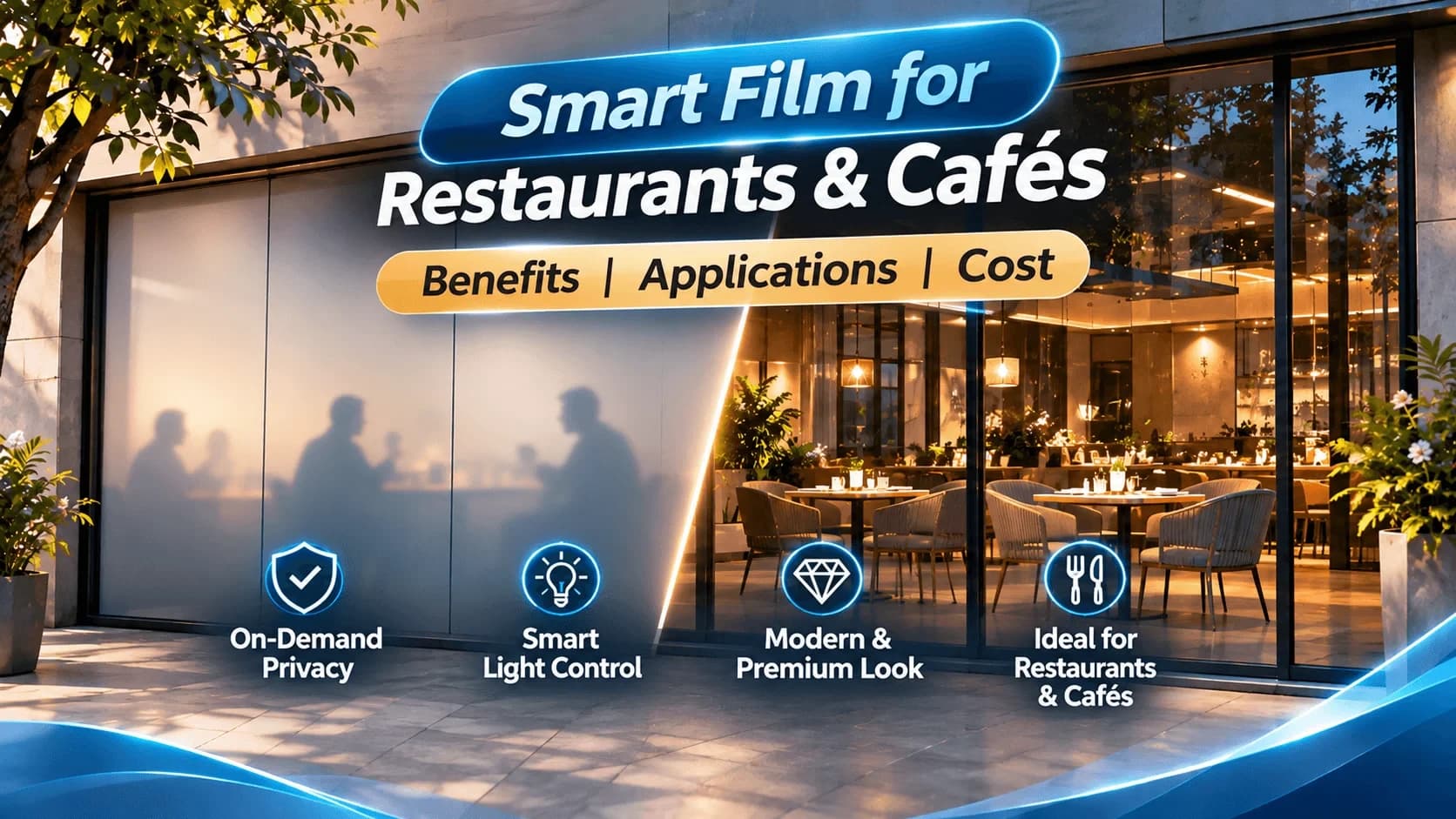
Smart film can be installed on the glass partitions surrounding private dining rooms. The glass can remain transparent when no private reservations are scheduled and switch to opaque mode when hosting customers who require greater privacy.
Partitions Between Seating Areas
Smart film helps divide seating areas without relying on solid walls. This preserves the feeling of spaciousness while allowing the level of privacy to be adjusted according to the needs of different guests.
Open Kitchens
Smart film can be used on glass partitions in open kitchens to control visibility between food preparation areas and customer seating spaces. However, the installation location must be carefully selected to avoid direct exposure to heat and moisture beyond the product's specified limits.
Glass Facades and Interior Glass
Smart film can be used on selected facades and interior glass partitions to create a modern appearance while allowing visibility to be controlled according to the nature of the business and the space's requirements.
How Does Smart Film Provide Privacy for Customers?
Privacy is one of the factors that influence the customer experience in restaurants and cafés, particularly when the venue has areas designated for families, business meetings, or private occasions. Smart film makes it possible to control visibility without changing the architectural design of the space.
For example, a restaurant owner can keep glass partitions transparent during regular business hours and activate privacy mode when a private room is reserved or an event is being held. This makes it possible to use the same space for multiple purposes instead of permanently dedicating rooms to private use.
It is important to understand that PDLC technology provides visual privacy by limiting direct visibility when the film is opaque. However, it does not necessarily block all light or eliminate shadows under every lighting condition. Therefore, the appropriate specifications should be selected based on the required level of privacy.
Smart Film vs. Frosted Glass and Traditional Curtains
When furnishing a restaurant or café, business owners may have to choose between frosted glass, curtains, or smart privacy film. The right option depends on the design, budget, and required level of flexibility.
Comparison Factor | Smart Film | Frosted Glass | Curtains |
|---|---|---|---|
Privacy control | Electric | Fixed | Manual |
Changing the glass state | Switches between transparent and opaque | Does not change | Does not change the glass itself |
Appearance | Modern glass finish | Provides permanent visual privacy | Depends on the fabric |
Flexibility | High | Limited | Moderate |
Electricity required | Yes | No | Usually no |
The main advantage of smart film is its ability to change the glass from one state to another without replacing it or adding movable barriers in front of it. Curtains may be suitable for certain designs and budgets, while frosted glass provides a permanent solution for spaces that do not require adjustable visibility.
What Factors Determine the Cost of Installing Smart Film in Restaurants?
The cost of installing smart film varies from one project to another. There is no single price that applies to all restaurants and cafés because the total cost depends on the glass area, film specifications, site conditions, and electrical installation requirements.
The main factors that affect the price include:
The total glass area to be covered, measured in square meters.
The type of smart film and its technical specifications.
The number, shapes, and dimensions of the glass panels.
The method used to install and conceal electrical wiring.
The required control system, whether traditional switches or smart controls.
Installation complexity and working conditions at the site.
It is therefore advisable to request a technical site inspection before proceeding. This allows the glass areas to be measured, project requirements to be identified accurately, and a detailed quotation to be prepared covering supply, installation, operation, and warranty.
Get Smart Film Solutions for Restaurants and Cafés from SmartVue
If you are planning to furnish a new restaurant or upgrade an existing café, SmartVue offers PDLC smart film solutions for interior glass applications, partitions, and commercial spaces across Saudi Arabia.
The company conducts a site inspection to identify suitable installation areas, then selects the film specifications and control system according to the intended use. The installation process includes cleaning the glass, preparing the film to the required dimensions, installing it, connecting the electrical system, testing its operation, and training the customer on how to use it.
SmartVue provides a written five-year warranty, subject to its warranty terms and conditions. Customers can also benefit from a free site inspection and a quotation tailored to their project requirements.
To inquire about smart film installation for restaurants and cafés, call +966580403303 or visit the official SmartVue website to request a site inspection for your project.
Frequently Asked Questions About Smart Film for Restaurants and Cafés
Can Smart Film Be Installed on Existing Restaurant Glass?
Yes. Adhesive smart film can be installed on many existing glass surfaces, provided they are suitable in terms of condition, surface characteristics, and intended use. A technical inspection is recommended to confirm that the glass is suitable before installation.
Does Smart Film Provide Complete Privacy in Restaurants?
When privacy mode is activated, smart film limits direct visibility. However, shadows may still be visible under certain lighting conditions or when someone is close to the glass. Therefore, the required level of privacy should be assessed before selecting the product.
Can Smart Film Be Controlled Using a Remote?
Yes. The system can be equipped with different control options depending on the project specifications. These include electrical switches, remote controls, and certain compatible smart home and building automation systems.
Does Smart Film Consume a Lot of Electricity?
Smart film operates using relatively low-voltage electricity. Its power consumption varies depending on the product type, installation area, and technical specifications. It is therefore advisable to consult the film's technical data sheet before installation.
Is Smart Film Suitable for Private Dining Rooms and VIP Areas?
Yes. It is a suitable application for these spaces because it allows glass partitions to remain transparent when needed and switch to privacy mode when hosting guests, meetings, or private events.
How Long Does Smart Film Installation Take in Restaurants and Cafés?
The installation period varies depending on the glass area, number of panels, and electrical wiring requirements. SmartVue indicates that project execution generally takes between 7 and 14 days, from the initial inspection to final operation, depending on the project's size and requirements.