
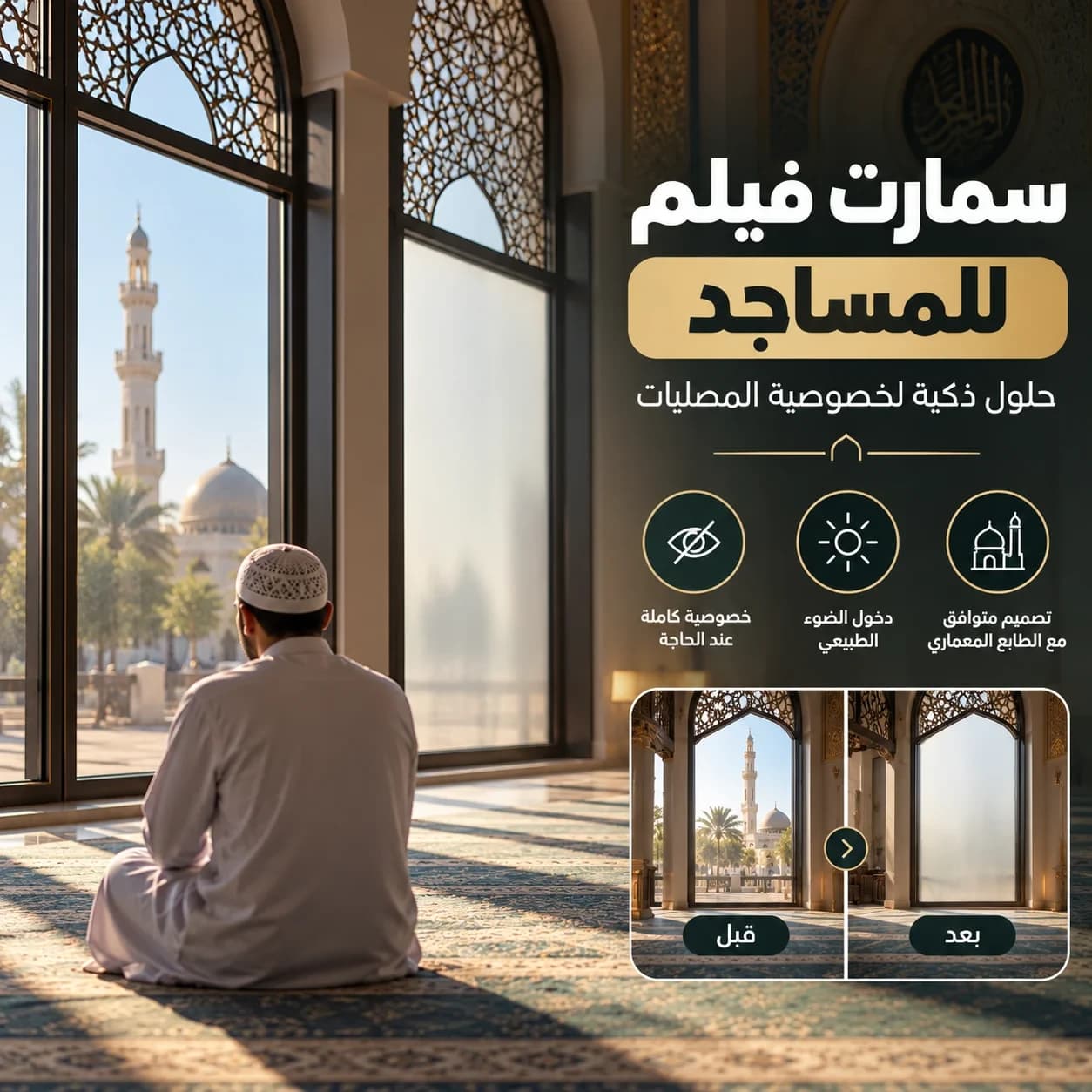
Mosques require practical solutions that provide privacy and organize interior spaces, particularly in women's prayer areas, Quran memorization rooms, and glass partitions. This is where smart film for mosques becomes important. This technology allows glass to switch from transparent to opaque at the touch of a button, eliminating the need for traditional curtains or, in many cases, complete glass replacement. It helps balance natural light with worshippers' privacy while preserving the mosque's architectural design. In this article, we will explore how smart film works, its main applications and benefits, and the factors to consider before installation.
What Is Smart Film for Mosques, and How Does It Work?
Smart film is an intelligent privacy film installed on suitable glass surfaces. Common types use PDLC technology, which stands for Polymer Dispersed Liquid Crystal. When electricity is switched on, the liquid crystals align to allow light to pass through more clearly. When the power is switched off, the crystals scatter light, giving the film a relatively opaque, white appearance. This allows users to control glass privacy as needed.
Transparency levels and performance vary depending on the product and installation conditions. Therefore, it is advisable to review the technical specifications before selecting a film for a mosque. It is also important to understand that the opaque mode does not necessarily block all light or provide complete sound insulation. The technology's primary function is to control visibility through glass.
Main Applications of Smart Film in Mosques
Smart film has various applications inside mosques, and suitable installation areas can be identified according to the building's design and daily activities. The most common applications include:
Women's prayer areas: Providing flexible privacy where glass partitions separate the prayer area from other spaces.
Quran memorization rooms: Allowing visibility when needed while reducing visibility during lessons or private activities.
Interior partitions: Organizing glass-enclosed spaces without relying on permanent solutions that may affect the appearance of the interior.
Administrative meeting rooms: Providing privacy during meetings while maintaining a modern appearance.
Multipurpose spaces: Adjusting privacy levels according to the activities taking place inside the mosque.
The appropriate application should be determined after inspecting the glass and understanding the mosque administration's requirements, while ensuring that emergency exits, circulation routes, and safety requirements are not affected.
Benefits of Smart Film for Mosques
Smart film for mosques offers several practical benefits, particularly in buildings with glass partitions that require different levels of privacy throughout the day. These benefits include convenient visibility control, preservation of the interior design, and the ability to make use of natural light whenever transparency is required.
The following benefits are worth considering before making a decision:
Privacy on demand: Switching between modes according to the space's needs.
Elegant architectural appearance: Reducing reliance on traditional curtains and visual barriers.
Making use of existing glass: Some types can be installed on existing glass if it is technically suitable.
Electrical control: Operating the system through a switch or a compatible control device.
Flexible space organization: Changing privacy levels without redesigning the partitions each time.
However, it should not be assumed that all film types provide the same level of ultraviolet protection or heat reduction. These properties depend on the product specifications and its verified test results.
Is Smart Film Suitable for Women's Prayer Areas?
Women's prayer areas are among the spaces that can benefit from switchable glass, particularly when a mosque's design needs to balance natural lighting and privacy. In some spaces, glass partitions can help distribute light and maintain a sense of openness. However, direct visibility may not meet users' needs at all times.
Installing suitable smart film makes it possible to change the glass's appearance when needed instead of relying permanently on curtains or fixed barriers. Before installation, it is important to determine the required coverage area, switch locations, wiring routes, and whether independent control is needed for each section of glass.
It is also advisable to test a film sample under actual lighting conditions to confirm that it provides the required level of privacy. The final appearance may be affected by lighting, viewing angles, and the type of glass.
Smart Film vs. Traditional Curtains
Choosing between smart film and curtains depends on the intended use, budget, and architectural design. Curtains are a traditional solution that can provide substantial visual screening depending on the fabric and installation method. However, they require space for movement, cleaning, and regular maintenance. Smart film, on the other hand, is installed directly onto the glass and allows users to switch between visibility modes electrically without moving a curtain.
Smart film also occupies no additional space inside the prayer area and can preserve the clean, minimalist appearance of glass partitions. However, it requires electrical components and professional installation. In addition, the opaque mode may appear white or hazy rather than completely blocking light.
Therefore, a proper comparison should consider more than appearance alone. It should also account for privacy levels, maintenance requirements, total cost, and operating needs.
How to Install Smart Film on Mosque Glass
Installing smart film for mosques begins with a technical inspection to determine the type, condition, and dimensions of the glass. The appropriate product is then selected based on the intended application. Next, the surfaces are prepared according to the manufacturer's instructions, the film is precisely cut and installed, and the electrical connections, power supply, and suitable control system are fitted.
The main installation steps include:
Measuring the glass and checking its suitability for installation.
Identifying the coverage areas and control locations.
Cleaning the surface and preparing and installing the film according to the specifications.
Completing the electrical connections in an organized and safe manner.
Testing the transition between transparent and opaque modes before handover.
The work should be carried out by qualified technicians. Electrical connections should be protected from moisture wherever necessary, and the film and its edges must be protected from damage during cleaning. The system should also be tested to ensure that it complies with the building's safety requirements.
What Factors Determine the Cost of Smart Film for Mosques?
There is no single price that applies to every mosque. The cost varies according to the glass area, film type, installation complexity, and required electrical components. A project involving one glass partition may cost differently from a project covering several prayer areas, Quran memorization rooms, and administrative spaces.
Before requesting a quotation, it is advisable to determine the approximate glass area, the number of zones requiring independent control, the condition of the existing glass, and the planned electrical wiring arrangement.
It is also helpful to ask about the written warranty, its coverage limitations, after-sales service, and the recommended methods for cleaning and maintaining the film. These details make it easier to compare quotations based on actual specifications rather than relying solely on the total price. A technical inspection helps identify the project's requirements and prepare a suitable quotation.
Get a Consultation for Smart Film Installation in Mosques from SmartVue
If you are planning to upgrade a women's prayer area or organize glass partitions inside a mosque, choosing the right solution begins with understanding the space's requirements and inspecting the glass before installation. SmartVue provides smart film and PDLC technology solutions in Saudi Arabia. You can contact the team to discuss your project requirements and identify suitable installation and control options.
Request a technical inspection to determine whether smart film is suitable for your mosque's glass and learn more about the specifications, cost, and warranty before making a decision. Visit the SmartVue website, call +966580403303, or email info@smartvue.co.
Frequently Asked Questions About Smart Film for Mosques
Can Smart Film Be Installed on Existing Mosque Glass?
Yes, adhesive smart film can be installed on many existing glass surfaces, provided that the glass type, condition, and installation method are suitable. A technical inspection will determine whether the surface is appropriate for installation.
Does Smart Film Provide Complete Privacy for Women's Prayer Areas?
When activated, the film reduces visibility according to the product's specifications. However, the actual level of privacy is affected by lighting, viewing angles, and film type. Testing a sample before covering the entire area is therefore recommended.
Does Smart Film Require Electricity?
Yes, PDLC-based smart film requires an electrical supply to switch to its transparent mode. When the power is disconnected, it typically returns to its opaque mode, depending on the product design.
Can Smart Film Be Controlled Using an Independent Switch?
Yes, the system can be designed so that a switch controls a specific area, or the glass can be divided into independently controlled zones. This depends on the wiring design and the control unit used.
What Is the Best Way to Determine the Cost of Smart Film for Mosques?
The process begins by measuring the glass, identifying its type and coverage area, and determining the required control method. You can then request a detailed quotation outlining the costs of materials, installation, electrical components, and warranty.