
When looking for a solution that combines privacy with a modern design, two main options stand out: ready-made smart glass and adhesive smart film. Both may use PDLC technology, which allows the glass to switch between transparency and privacy when electrical power is controlled. However, their manufacturing methods, installation processes, and applications differ significantly. Therefore, choosing the right option does not depend on price alone. It also depends on the condition of the existing glass, the nature of the project, the required level of durability, and whether the project is new or involves upgrading existing glass.
What Is Ready-Made Smart Glass and How Does It Work?
Ready-made smart glass is a glass unit manufactured from the beginning with the PDLC layer integrated into its structure rather than being applied over an existing glass surface. When electrical power is supplied, the liquid crystals inside the layer align, making the glass transparent. When the power is turned off, the light becomes scattered, turning the surface opaque and providing visual privacy.
Where Is Smart Glass Most Suitable?
Smart glass is a practical choice for new projects where the glass is manufactured and installed from the beginning, such as interior partitions, meeting rooms, glass doors, glass walls, and high-end projects where technology integration is part of the overall design. Its main advantage is that it provides a seamless appearance without a visible adhesive layer on the glass surface.
What Is Adhesive Smart Film and What Are Its Benefits?
Adhesive smart film is a thin PDLC layer with an adhesive backing that can be installed directly onto existing glass instead of replacing the entire glass unit. This feature makes it particularly suitable for renovation and upgrading projects in offices, homes, clinics, and hotels.
The main benefits of smart film include:
Converting existing glass into a smart privacy surface.
Reducing the need to remove and replace existing glass.
Providing instant privacy when the system is activated.
Integrating with switches or smart control systems depending on the setup.
Being suitable for projects where the existing glass units do not need to be replaced.
Giving spaces a modern appearance without traditional curtains.
Some commercial PDLC film specifications indicate fast switching speeds and low power consumption while in the transparent state. However, actual performance varies depending on the product and installation method.
Difference Between Ready-Made Smart Glass and Adhesive Smart Film
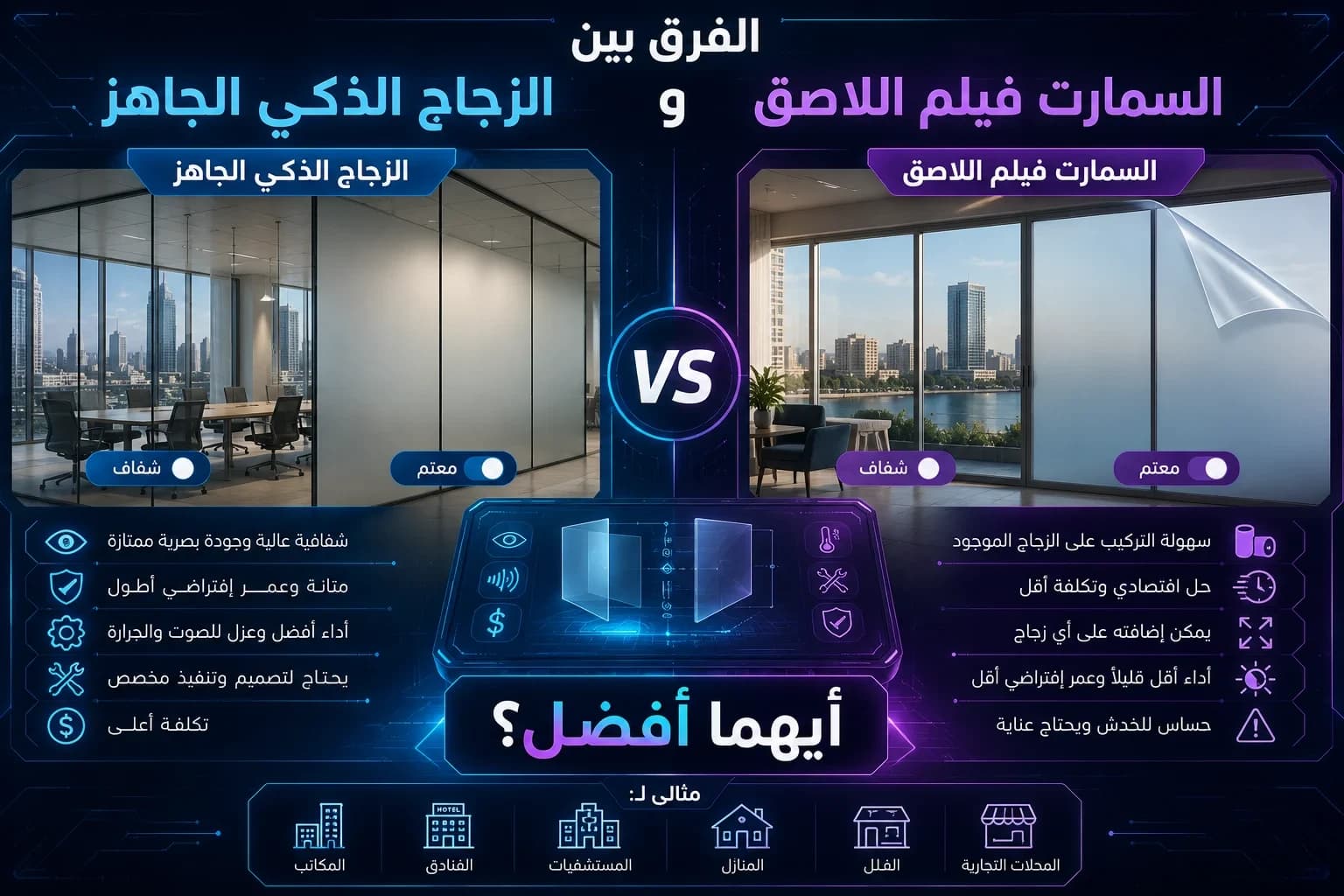
The main difference between ready-made smart glass and adhesive smart film is their manufacturing and installation method. Ready-made smart glass is manufactured with the privacy technology integrated into the glass layers, making it more suitable for new projects where the glass is selected before construction. Adhesive smart film, on the other hand, is installed directly onto existing glass, making it a practical option when upgrading a space without completely removing the existing glass.
Ready-Made Smart Glass
Ready-made smart glass comes as an integrated unit designed with the technology incorporated during the manufacturing stage. This makes it suitable for new projects and construction where glass partitions or doors are designed from the beginning.
Adhesive Smart Film
Adhesive smart film offers greater flexibility because it can be applied to existing glass. In many cases, there is no need to replace the entire glass unit. This makes it suitable for offices, villas, clinics, and meeting rooms that need to add smart privacy after the glass has already been installed.
The main practical differences include:
Installation method: Smart glass is manufactured with the technology integrated from the beginning, while smart film is applied to existing glass.
Renovation: Smart film is more suitable for upgrading existing spaces without completely replacing the glass.
Design: Smart glass provides an integrated solution from the manufacturing stage, while smart film adds a smart layer to the glass surface.
Flexibility: Smart film provides more options when working with existing glass.
Cost and installation: Costs vary depending on the project size, glass type, film specifications, installation work, and electrical requirements. Therefore, it is not possible to determine which option is cheaper in every case without assessing the project.
In general, if the project is new and you are still at the stage of selecting the glass, ready-made smart glass may be suitable. However, if you already have existing glass and want to convert it into smart privacy glass without replacing it, adhesive smart film is usually the more flexible and practical solution.
Benefits of Smart Film That Make It a Practical Choice
The main strength of smart film is that it can be used with existing glass. If you have a meeting room, office, or glass room and want to add privacy without completely changing the façades or partitions, smart film can provide a more flexible solution.
PDLC technology also allows privacy to be controlled on demand. In traditional systems, the film becomes opaque when the power is turned off and transparent when the power is switched on. Some systems can also be integrated with different control methods, such as switches, remote controls, or automation systems, depending on the product used.
Suitable for Renovation Without Replacing the Glass
This particular advantage makes smart film attractive for offices, homes, and facilities where glass has already been installed. Instead of removing the existing glass and installing new units, the surface can be upgraded using a suitable film, provided that the glass condition and installation method are appropriate.
Is Smart Film Better Than Ready-Made Smart Glass?
If the project is new and you are still at the stage of selecting and manufacturing the glass, ready-made smart glass may be suitable because the technology is integrated into the unit from the beginning. However, if you already have existing glass and want to add smart privacy without replacing it, smart film is generally the more practical option.
Specialized sources indicate that adhesive film is primarily designed for retrofitting existing glass, while smart glass is manufactured as an integrated unit with the PDLC layer incorporated into its structure.
The decision can therefore be summarized as follows:
New project: Ready-made smart glass is worth considering.
Existing glass: Smart film offers greater flexibility.
Office or villa renovation: Film may reduce the amount of modification required.
High-end project requiring technology integration from the beginning: Smart glass may be the better choice.
What Are the Disadvantages of Adhesive Smart Film?
Despite its benefits, smart film is not suitable for every application. Because it is installed on the surface of the glass, the final result depends significantly on the quality of the existing glass, surface cleanliness, cutting and installation accuracy, and electrical connections. The exposed film also requires selecting a product suitable for the environment in which it will be used.
Some specialized sources indicate that switchable films require careful handling and installation because damage, bending, or improper handling can affect the liquid crystal layer.
For this reason, installation should not be treated as a simple application process, especially for large-scale or commercial projects.
When Should You Choose Ready-Made Smart Glass?
Choose ready-made smart glass when you are at the design or construction stage and want an integrated solution from the beginning. This option is suitable when the priority is a seamless final appearance, durability, and integrating the technology into the glass unit rather than adding it later.
For projects that already have existing glass and do not require replacement, replacing the entire glass unit may be more complicated and costly than adding a suitable adhesive PDLC film.
When Is Smart Film the Better Choice?
Smart film is a strong option when you already have existing glass façades or partitions and want to add smart privacy with minimal modification. It can be used in offices, meeting rooms, homes, clinics, hotels, and other spaces that require a quick transition between openness and privacy.
Its flexibility also makes it suitable for projects where requirements may change over time, particularly when the property owner wants to keep the existing glass and benefit from it rather than replace it.
Get the Right Glass Solution for Your Project with SmartVue
If you are unsure whether to choose ready-made smart glass or adhesive smart film, the decision should not be based on price alone. The type of existing glass, project size, installation location, daily usage, design, and control method all influence the right choice. SmartVue provides smart film and smart privacy film solutions in Saudi Arabia, along with site assessments to determine the most suitable solution according to each project's requirements.
Frequently Asked Questions About Smart Glass and Smart Film
Is Smart Film Better Than Smart Glass?
It depends on the project. Smart film is highly suitable for existing glass, while ready-made smart glass is more suitable for new projects where the glass can be manufactured with the technology integrated from the beginning.
Can Smart Film Be Installed on Existing Glass?
Yes. Adhesive smart film is primarily designed to be installed on existing glass surfaces, provided that the glass and its condition are suitable for installation.
Does Smart Film Provide Complete Privacy?
PDLC technology switches the film to an opaque state when the power is turned off, providing a high level of visual privacy. However, the actual level of opacity varies depending on the product quality and specifications.
Does Smart Film Consume a Lot of Electricity?
Traditional smart film systems require electricity to maintain the transparent state, while they do not consume power in the opaque state. Power consumption varies depending on the product and its technical specifications.
Can Smart Film Be Controlled by Phone?
Some smart film systems can be integrated with mobile applications or smart automation systems, depending on the controller and equipment used in the project.