

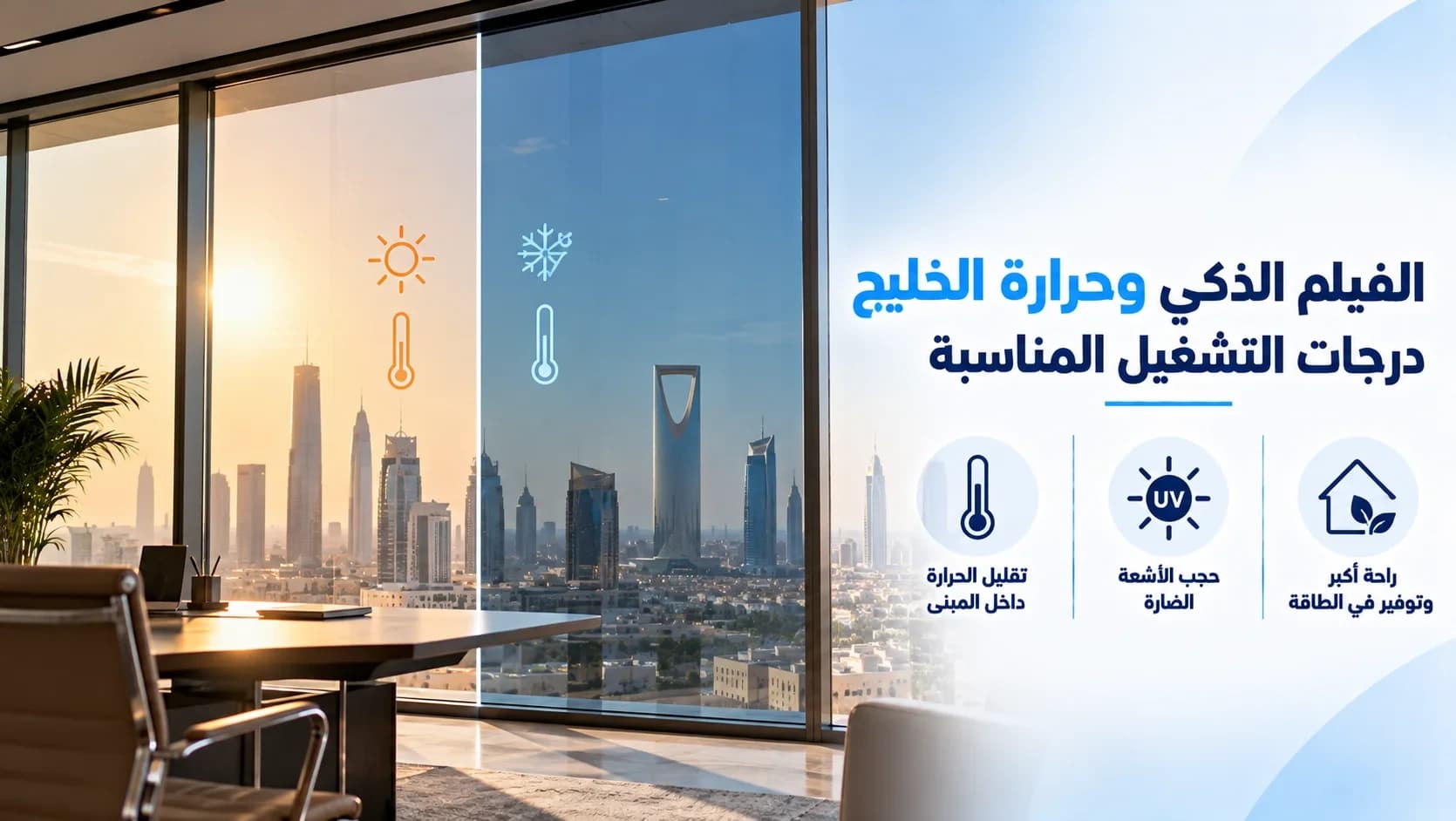
Smart film solutions in Saudi Arabia face a real test during the summer months, especially when glass is exposed to direct sunlight for long periods. Therefore, when choosing PDLC film, it is not enough to consider switching speed or privacy level alone. You should also understand the permitted operating temperature, the installation environment, and how the film will be protected from excessive heat.
More importantly, outdoor air temperature is not the same as the surface temperature of the glass. Glass exposed to direct solar radiation can become significantly hotter than the surrounding air, making the film’s specifications and compatibility with the glass an essential factor in the long-term success of the project.
This is why Gulf heat should be treated as a design consideration from the beginning rather than a problem that appears after installation. Choosing the right film, determining the appropriate location for the transformer, inspecting the glass, and ensuring high-quality electrical connections can all help reduce the risk of performance degradation.
Can Smart Film Withstand High Gulf Temperatures?
Yes, smart film can be used in hot environments, but the exact answer depends on the product type and its specifications. Some PDLC products are published with operating temperatures of up to 70°C, while others are rated up to 80°C. Some products list different ranges, such as -30°C to 76°C. Therefore, it is not appropriate to apply a single temperature rating to all types of smart film.
For projects in Saudi Arabia, it is better to select the product based on its technical data sheet rather than the technology name alone. You should also distinguish between operating temperature and storage temperature, as a product may allow storage at a higher temperature than the maximum permitted during operation.
What Is the Operating Temperature of Smart Film?
Published specifications for different PDLC products indicate operating ranges such as -20°C to 70°C and -20°C to 80°C, while other products have different specifications. This shows that the operating temperature of smart film is not a fixed standard across all companies and models.
Difference Between Operating and Storage Temperature
Operating temperature refers to the range within which the film is designed to function while maintaining the properties specified by the manufacturer. Storage temperature refers to the conditions the product can withstand while it is not in use. Confusing these two figures can lead to selecting an unsuitable product for a location exposed to direct sunlight.
How Does Sun Exposure Affect Smart Film Performance?
High temperatures do not automatically mean that the film will be damaged, but they make product selection and proper installation more important. PDLC contains liquid crystals within a polymer material, and the properties of these materials can be affected by temperature. Recent research indicates that some PDLC formulations can maintain stable switching performance at elevated temperatures, but laboratory results do not mean that every commercial product offers the same performance.
Glass exposed to direct sunlight also differs from indoor glass away from solar radiation. Therefore, the facade orientation, glass area, shading, and type of glass should be evaluated before selecting the appropriate solution.
Can Smart Film Be Installed on Sun-Exposed Glass?
It can be installed in many cases, but you must ensure that the film’s specifications and installation method are suitable for the actual conditions. Some commercial products explicitly advertise resistance to sunlight or high operating temperature ranges, while others have lower limits. Therefore, simply describing a product as “heat resistant” is not enough to make a technical decision.
For facades with significant sun exposure, it is preferable to review the technical data sheet and obtain written confirmation from the supplier regarding the operating temperature, adhesive type, film compatibility with the glass, and any limitations for external applications if the film will be used outdoors.
How Can You Maintain Smart Film in Saudi Arabia’s Climate?
Maintaining smart film performance depends not only on temperature but also on product quality, installation quality, and electrical components. Key practices include:
Choosing a film suitable for the temperatures expected at the installation site.
Installing the film according to the manufacturer’s instructions.
Avoiding exposure of connections and electrical components to unsuitable moisture or heat.
Ensuring that the glass and application are compatible with the selected product.
Keeping the product specifications and warranty information for future maintenance.
Professional installation is also important for reducing issues such as bubbles, edge separation, or damaged connections. These problems can affect the product’s lifespan and performance even when the film itself is high quality.
Does Smart Film’s Thermal Insulation Prevent It From Heating Up?
Smart film can help control light and reduce some effects of solar radiation, but it should not be considered a complete substitute for high-performance glass or shading and insulation systems designed for thermal control. The ability to block infrared radiation and heat varies from one product to another, so solar energy transmission data and the properties of both the glass and film should be considered together.
A recent field study indicates that using PDLC in its opaque state can help limit increases in indoor temperatures during periods of high solar radiation, supporting its role as part of a thermal control strategy rather than as a standalone solution for all heat-related problems.
When Do You Need Smart Film With a Higher Operating Temperature?
Choosing PDLC with a suitable thermal range becomes more important when the glass is close to an exterior facade exposed to direct sunlight, when the glass area is large, or when adequate shading is not available. In these situations, choosing film based only on privacy and switching speed is not sufficient.
The right decision starts with evaluating the site: glass orientation, hours of sun exposure, glass type, availability of external shades or blinds, and the expected temperature on the glass surface. These conditions can then be matched with the product’s technical data sheet before installation.
Some companies also publish heat, humidity, and thermal shock testing as part of their product evaluations. This can be a useful indicator when comparing options, but it does not replace reviewing the specifications of the specific model that will be installed in the project.
Get the Right Consultation for Your Project in Saudi Arabia
Choosing the right smart film for the Gulf climate should be based on actual specifications rather than a general marketing figure. If your project is in Riyadh or another Saudi city and includes glass exposed to sunlight, a technical site assessment can help determine the appropriate PDLC type, installation method, and operating requirements based on the site conditions.
SmartVue provides smart privacy film solutions in Saudi Arabia, with project assessment and specialized installation. Its team can evaluate the glass and installation location before determining the appropriate solution.
Frequently Asked Questions About Smart Film and Temperature
What Is the Highest Temperature Smart Film Can Withstand?
There is no single temperature that applies to all products. Published specifications vary. Some films specify operation up to 70°C, others up to 80°C, while other products have different ranges. Therefore, you should rely on the data sheet for the specific model.
Does Saudi Arabia’s Heat Affect Smart Film?
It can affect the film if the temperature at the installation site exceeds the product’s permitted operating range. Therefore, the film should be selected based on the actual conditions of the glass rather than air temperature alone.
Is Smart Film Suitable for Windows Exposed to Sunlight?
It can be suitable, provided that the product is compatible with the application and expected temperatures. Sun-facing glass requires more careful technical evaluation than indoor or shaded glass.
Does Smart Film Provide Thermal Insulation?
Some types of smart film can help control solar radiation, but thermal performance varies between products. Smart film should not be considered a standalone replacement for insulation or glass specifically designed for solar control.