
Smart glass types have become modern solutions that combine privacy, light control, and contemporary design, but each technology works differently and is suited to specific applications. Among the most popular technologies are PDLC glass, electrochromic glass, and SPD glass, which differ in switching speed, light-control method, privacy level, and energy consumption. Therefore, before choosing switchable glass for an office, home, or building facade, it is important to understand the practical differences between these systems. In this article, we explore the most important smart glass technologies, the advantages of each technology, and their key applications to help you choose the most suitable solution for your project.
What Is Smart Glass and How Do Its Technologies Work?
Smart glass is a glazing system that can change its optical properties when electrically controlled, allowing its transparency or tint level to change depending on the technology used. The most common smart glass types include technologies based on liquid crystals, suspended particles, or electrochromic materials. Although the final result may appear similar to the user, each technology works differently. Some systems are primarily designed to provide instant privacy, while others focus on controlling sunlight, glare, and heat. Therefore, there is no single technology that is suitable for every project. The choice depends on the intended use, the glass location, and the desired outcome.
The Difference Between Tinting and Privacy
It is important to distinguish between tinting and privacy when choosing switchable glass. Tinting means reducing the amount of light passing through the glass, while privacy means limiting visibility through it. PDLC technology, for example, is designed to provide a clear transition between transparent and opaque states, making it suitable for meeting rooms and interior partitions that require privacy on demand.
PDLC Glass: Instant Privacy at the Touch of a Button
PDLC glass is one of the most popular switchable glass solutions. It uses a layer containing liquid crystals dispersed within a polymer. When electrical power is applied, the crystals align and allow light to pass through more clearly. When the power is turned off, the crystals return to a random state, scattering light and making the glass appear opaque or semi-opaque.
One of the main advantages of PDLC is its fast transition between the two states. For this reason, it is widely used in offices, meeting rooms, clinics, hospitals, hotels, and homes. The technology can also be implemented as smart glass manufactured from the beginning or as Smart Film that can be installed onto existing glass. This provides a practical option when upgrading a space without completely replacing the existing glass panels.
Electrochromic Glass: Gradual Lighting Control
Electrochromic glass uses electrochromic materials that change their optical properties when an electrical voltage is applied. Unlike PDLC, which switches quickly between two distinct states, electrochromic glass can transition between different tint levels, making it suitable for controlling the amount of light, glare, and solar heat.
Where Is Electrochromic Glass Used?
This type of glass is particularly used in windows, large glass facades, and buildings that require control over solar radiation while maintaining natural daylight. One of its key advantages is that the system generally does not require continuous power to maintain the selected tint level once it has been reached, making it different from some glass technologies that require continuous power to maintain their state.
SPD Glass: Gradual Tinting and Light Control
SPD glass uses microscopic particles suspended within a functional layer. The arrangement of these particles can be controlled using an electric field. As a result, the system can change the amount of light passing through the glass across multiple levels rather than relying solely on transparent and opaque settings.
This technology is particularly valuable in applications where controlling light intensity, glare, and heat is more important than providing complete privacy. For this reason, SPD technology can be found in certain automotive and aviation applications, as well as windows and glass roofs. Its suitability depends on the nature of the project and the required level of light control.
What Is the Difference Between PDLC, Electrochromic, and SPD?
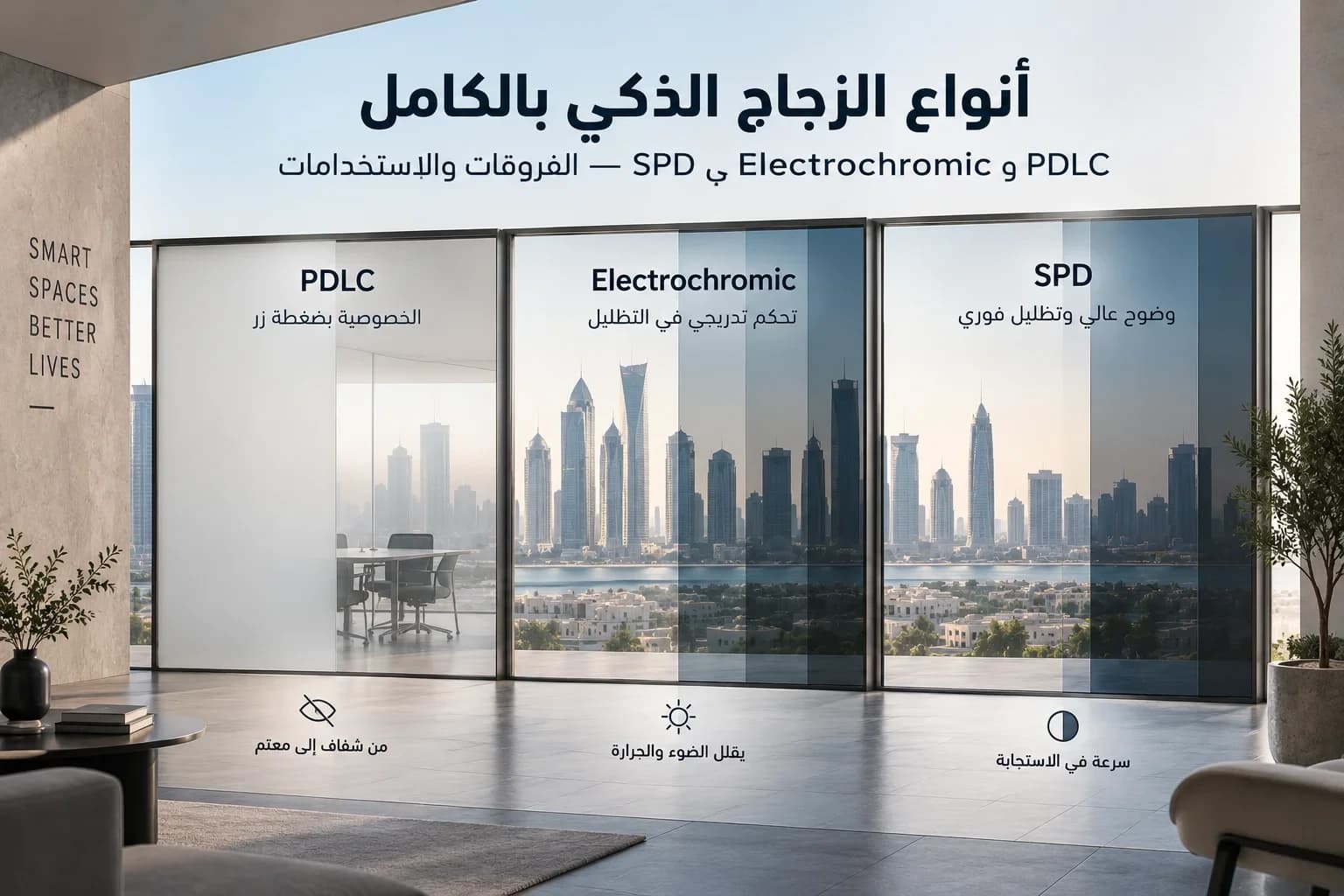
Although all three technologies fall under smart glass technologies, each has a different primary function. PDLC focuses on instant privacy and fast switching between transparent and opaque states, while Electrochromic relies on gradual tinting to control light and heat. SPD provides adjustable control over light transmission and glare.
The choice can therefore be summarized practically as follows:
PDLC: Suitable when fast privacy is the priority.
Electrochromic: Suitable for windows and facades that require control over sunlight and glare.
SPD: Suitable for applications that require adjustable and relatively fast tinting.
Smart Film: A practical solution when adding privacy functionality to existing glass.
Smart Glass Applications in Homes and Offices
The applications of smart glass types vary depending on the technology and location. In offices, PDLC can be used in meeting rooms and glass partitions to provide privacy when needed while maintaining an open appearance when privacy is not required. In homes, it can be used in bathrooms, interior partitions, and certain windows.
For exterior facades, tinting technologies such as Electrochromic and SPD are more closely associated with controlling sunlight, glare, and heat. Therefore, the system should be selected based on the nature of the project rather than simply choosing a technology by name.
How Do You Choose the Right Switchable Glass for Your Project?
Choosing the right switchable glass starts with identifying the primary purpose of the installation. If the goal is to provide instant privacy inside a meeting room, office, or clinic, PDLC is generally the technology most closely associated with this application. If the goal is to reduce glare and control sunlight on an exterior facade, Electrochromic or SPD can be considered.
You should also consider the glass area, installation method, power source, control system, operating conditions, and total project cost. For existing glass, PDLC Smart Film can be a practical option instead of replacing the entire glass panel.
Get the Right Smart Glass Solution for Your Project with SmartVue
Choosing the right technology is not only about wanting modern glass. It also depends on the needs of the space, its intended use, and the required level of privacy. If you are looking for an instant privacy solution for offices, homes, or meeting rooms, SmartVue provides PDLC-based Smart Film solutions that can be installed on existing glass.
You can contact the SmartVue team for an assessment and evaluation of your project requirements and to select the appropriate solution, whether your goal is to add privacy, enhance the design of the space, or achieve more flexible control over your glass.
Frequently Asked Questions About Smart Glass Types
What Are the Types of Smart Glass?
The most common smart glass types include PDLC, SPD, and Electrochromic technologies. These technologies differ in how they control light, how quickly they change their transparency levels, their privacy capabilities, and the applications for which each is suitable.
What Is the Difference Between PDLC Glass and Electrochromic Glass?
PDLC glass is known for its fast transition between transparent and opaque states, which makes it widely used for privacy applications. Electrochromic glass, on the other hand, changes its tint level gradually and is more commonly used to control light, glare, and solar heat.
Does SPD Glass Provide Complete Privacy?
The primary purpose of SPD glass is to control light transmission, tinting, and glare rather than provide complete privacy. Therefore, if privacy is the main requirement, PDLC is generally more suitable for this type of application.
Can PDLC Glass Be Installed on Existing Glass?
Yes, adhesive PDLC Film can be used as a solution for upgrading existing glass without replacing the entire glass panel. Installation feasibility varies depending on the condition and dimensions of the glass, as well as the required mounting method and electrical connections.
Which Smart Glass Technology Is Suitable for Offices?
If the goal is to switch meeting rooms or glass partitions from transparent to opaque when needed, PDLC is one of the most suitable options. However, if the project involves large exterior facades and requires control over sunlight and glare, technologies such as SPD or Electrochromic may be more appropriate.