
Smart glass is becoming an increasingly attractive option for homeowners who want more control over privacy, sunlight, comfort, and interior design. Unlike conventional windows that remain permanently transparent, smart glazing can change its visual state through an electrical control system, depending on the technology selected. Some solutions focus on instant privacy, while others are designed primarily to control sunlight and solar heat. For homes and luxury villas, the appeal is clear: one glass solution can contribute to a cleaner architectural appearance while giving occupants greater control over their environment. This guide explains how the technology works, what it can offer, how much it may cost, and how to select the right solution for your property.
What Are Smart Glass Windows and How Do They Work?
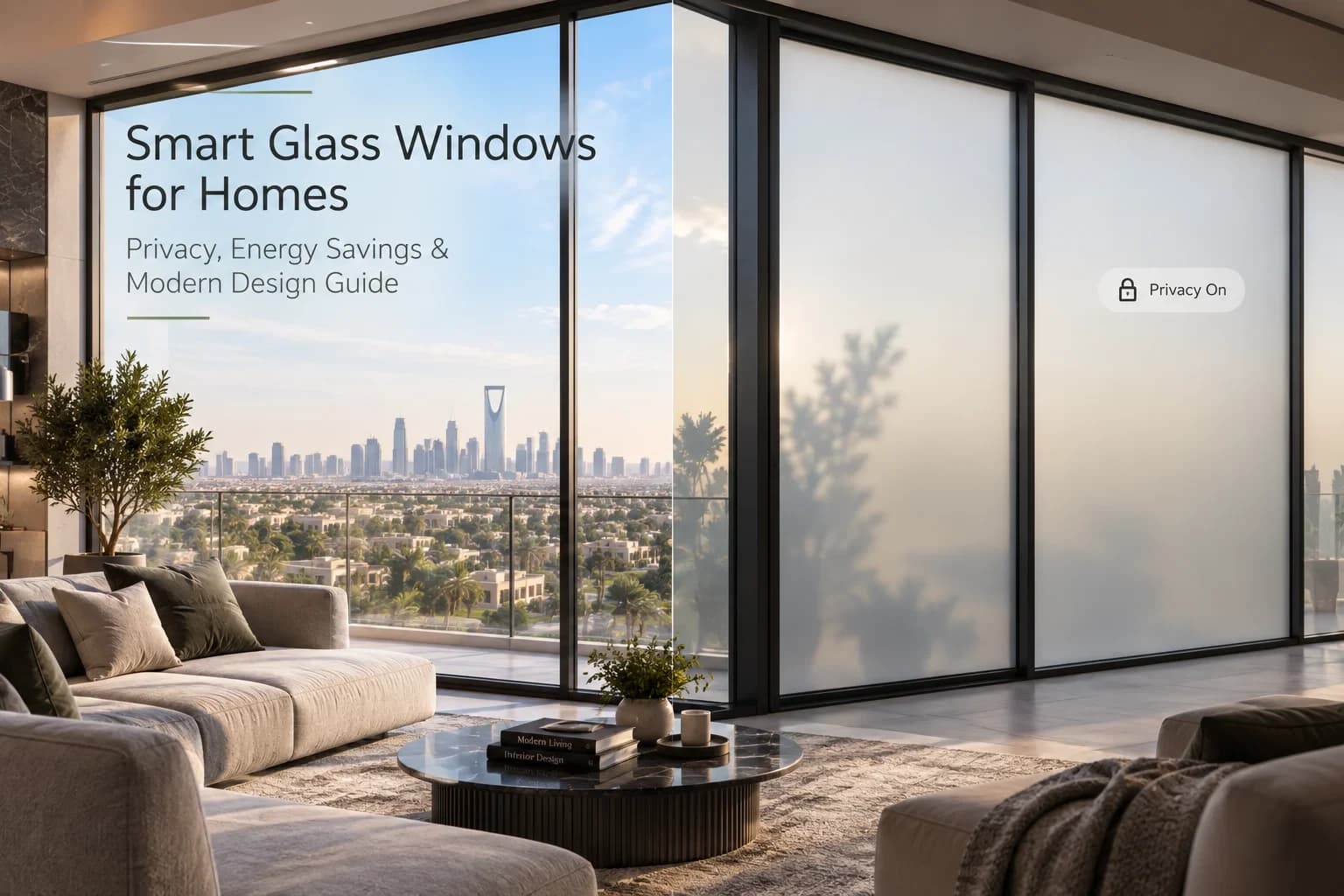
Smart glass windows are glazing systems that can change their optical properties when activated. Depending on the technology, the glass may become darker, lighter, or more opaque. PDLC switchable glass, for example, uses an electrically controlled liquid-crystal layer that changes between a transparent and privacy state. Electrochromic technology works differently by gradually changing its tint to regulate light and solar heat. This distinction is important because not every smart window provides the same type of privacy or energy performance. SmartVue focuses on PDLC smart film solutions that can be applied to suitable existing glass, allowing homeowners to upgrade their spaces without necessarily replacing the entire glazing system.
How Do Switchable Glass Windows Improve Home Privacy?
One of the strongest reasons homeowners consider switchable glass is on-demand privacy. Instead of permanently covering a window with curtains, blinds, or traditional frosted glass, switchable glass can change its appearance when privacy is required. This can be particularly useful for bathrooms, bedrooms, entrance areas, internal partitions, and street-facing spaces where privacy requirements change throughout the day. Residential switchable glass systems can also be controlled through switches, remotes, mobile devices, or smart-home systems, depending on the selected installation. SmartVue states that its PDLC solution can transition between transparent and opaque states and can integrate with systems such as Alexa, Google Home, and KNX.
Can Smart Glass Windows Help Reduce Energy Costs?
Energy performance depends heavily on the type of smart glazing, window orientation, climate, glass specification, and how the system is controlled. Electrochromic windows can reduce solar heat gain by dynamically changing their tint, which may reduce the cooling load in buildings exposed to strong sunlight. Research published by the U.S. Department of Energy has documented the potential of dynamic glazing to control light and heat transmission, while research in a hot, dry Egyptian climate found significant reductions in simulated cooling loads with electrochromic glazing under certain window configurations. However, smart glass should not automatically be marketed as a guaranteed percentage reduction in every home. The actual result depends on the building and installation.
Smart Windows Cost: What Affects the Price?
Smart windows cost more than conventional glazing because the final project may include the smart layer, glass specification, electrical components, controls, installation, and sometimes new frames. Current U.S. cost guides place professionally installed smart glass broadly around $50–$150 per square foot, while retrofit smart film can fall into a lower range depending on the product and project requirements. These figures should be treated as market references rather than a fixed price for Saudi projects. For a villa or home, the final quotation can change significantly according to glass dimensions, number of panels, whether existing glass can be used, control requirements, wiring, and installation conditions. A professional site assessment is therefore more useful than relying on a generic price per square foot.
What Makes a Smart Glass Project More Expensive?
Large glass areas, custom shapes, difficult access, new glazing units, complex electrical routing, and advanced automation can all increase the project budget. Retrofit smart film may be particularly attractive when the existing glass is structurally suitable, because the property may not require complete window replacement. For new construction, integrated smart glass can be considered during the architectural and glazing design stage. The best choice should balance the property's existing conditions, privacy requirements, thermal objectives, aesthetics, and long-term maintenance rather than focusing only on the initial purchase price.
Electrochromic Windows vs. Switchable Smart Glass
Electrochromic windows and PDLC switchable glass are both considered smart glazing, but they solve somewhat different problems. Electrochromic windows generally change tint gradually to control sunlight, glare, and solar heat while maintaining a view. PDLC technology is better known for rapid privacy switching, changing between a transparent and opaque or translucent appearance when powered. Therefore, a homeowner looking primarily for solar-control performance may consider electrochromic technology, while someone who wants instant visual privacy for a bathroom, bedroom, or internal glass partition may prefer a switchable PDLC solution. The right choice depends on whether privacy, solar control, aesthetics, retrofit capability, or automation is the primary objective.
Smart Glass for Villas: Best Applications for Modern Homes
Smart glass for villas can be used in areas where conventional glass creates a conflict between openness and privacy. Bedrooms overlooking neighboring properties, bathroom partitions, entrance doors, home offices, large living-room windows, and internal glass walls are all potential applications. In luxury residential design, the technology can also complement minimalist architecture by reducing the visual dependence on curtains and permanent partitions. SmartVue specifically positions its PDLC solutions for villas and luxury residential spaces, while its technology can be controlled through remote systems and integrated with selected smart-home platforms. For existing villas, smart film can also provide a retrofit approach when the current glass is appropriate for installation.
How to Choose Privacy Glass for Homes?
Choosing privacy glass for homes should start with the room rather than the product name. A bathroom may need a different solution from a large living-room façade because humidity, sunlight exposure, glass size, and the desired privacy state can differ. Homeowners should consider whether they need instant opaque privacy or gradual solar tinting, whether the existing glass can be upgraded, how the system will be powered, and whether remote or smart-home control is important. It is also useful to request technical specifications and, where possible, see a working sample before making a final decision. Professional assessment can help determine whether smart film, integrated switchable glass, or another glazing solution is the better fit.
Upgrade Your Home With Smart Glass From SmartVue
For homeowners and villa owners in Saudi Arabia, SmartVue provides PDLC smart film solutions designed to add controllable privacy and a modern appearance to suitable glass surfaces. The company describes itself as a Saudi smart-film specialist and offers solutions for residential and commercial spaces. Its product information highlights instant switching, UV protection, heat reduction, simple maintenance, and compatibility with selected smart-home systems. SmartVue also offers customized quotations based on the project requirements rather than relying on a one-size-fits-all specification.
If you are planning a smart glass project, the practical next step is to assess your existing windows, identify the rooms where privacy or solar control matters most, and determine whether retrofit smart film or integrated smart glass makes more sense. Request a customized SmartVue consultation
Frequently Asked Questions About Smart Glass Windows
Are smart glass windows worth it for a home?
They can be worthwhile when privacy, glare control, modern design, or smart-home integration is a priority. Their value depends on the property, the selected technology, installation requirements, and the number and size of windows involved. They are usually best evaluated as a complete project rather than by comparing the glass price alone.
How much do smart glass windows cost?
Smart windows do not have one universal price. Current market references show professionally installed smart glass commonly ranging from about $50 to $150 per square foot in the U.S., while retrofit smart film may cost less depending on specifications. Local pricing should be based on measurements, product type, electrical requirements, and installation conditions.
Can smart glass be installed on existing windows?
In suitable cases, smart film can be applied to existing glass, making it a potential retrofit solution. However, the glass condition, surface type, dimensions, installation environment, and electrical requirements should be checked before installation.
Do smart windows save electricity?
They can contribute to energy savings when the selected technology reduces solar heat gain and is appropriately controlled. The actual savings vary according to climate, orientation, glazing specifications, shading, and building operation, so no single savings percentage applies to every home.
What is the difference between smart glass and smart film?
Smart glass has the smart technology integrated into the glass unit itself, while smart film can be applied to suitable existing glass in retrofit applications. Integrated smart glass can be attractive for new construction, whereas smart film may be useful when homeowners want to upgrade existing glazing without replacing the complete glass unit.