
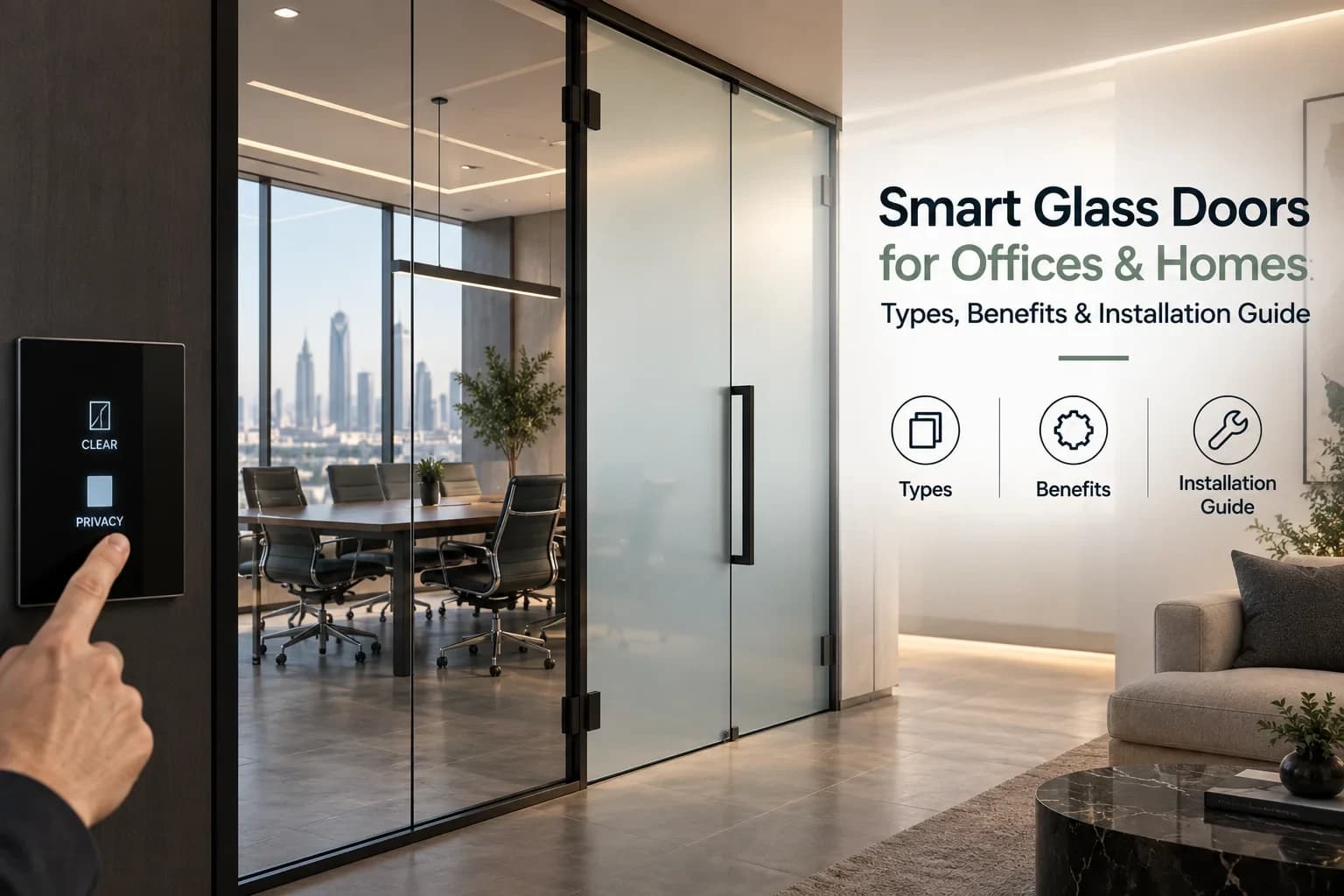
Smart glass doors are changing how offices and homes manage privacy without giving up natural light or a clean architectural look. Unlike conventional glass doors, switchable systems can move between a clear state and a privacy state when electrically controlled. This makes them useful for meeting rooms, executive offices, bathrooms, bedrooms, and flexible interior spaces. The key is choosing the right system for the project: new smart glass, retrofit PDLC film, or a complete partition solution. In this guide, we explain the main types, practical benefits, installation considerations, and the questions buyers should ask before ordering.
What Are Smart Glass Doors and How Do They Work?
Smart glass doors use switchable glazing technology to change their visual appearance on demand. The most common approach is PDLC, where liquid-crystal material changes how light passes through the glass when electrical voltage is applied. In one state, the panel is clear; in the privacy state, it becomes translucent or frosted. This creates visual privacy without adding curtains or blinds. Switchable glass doors can be specified for hinged, sliding, and some frameless applications, but the electrical design must be considered with the door hardware. For sliding doors, power transfer through the moving system needs particular attention during design and installation.
Types of Smart Glass Doors to Consider
There are three practical ways to build a smart door solution. Factory-made switchable laminated glass integrates the PDLC layer into the glazing and is usually considered for new construction. Retrofit PDLC film is applied to suitable existing glass, making it useful when replacing the door is undesirable. Smart glass partitions can also combine doors and fixed panels into one privacy-controlled system. The best option depends on the existing glass, safety requirements, dimensions, wiring access, and whether the project is new or a renovation. A qualified supplier should assess the complete assembly rather than choosing the film or glass alone.
Switchable Glass Doors vs. PDLC Glass Doors
The terms are often used interchangeably, but a useful distinction is that switchable glass normally refers to a complete glazing unit, while PDLC glass doors describe the technology used to create the switching effect. For an existing door, PDLC film may be the more practical retrofit route.
Smart Glass Doors for Offices and Meeting Rooms
In offices, privacy often needs to change throughout the day. A meeting room can remain visually open during normal work, then become private for interviews, HR discussions, finance meetings, board sessions, or client consultations. Smart glass partitions and doors support this flexibility while preserving the bright appearance of glazed interiors. They are particularly useful where designers want daylight to move through the workspace without leaving confidential activities permanently exposed. This is why office glass doors privacy solutions are increasingly considered for modern meeting rooms and executive spaces. However, visual privacy is not the same as soundproofing. Acoustic performance depends on the full door or partition construction, including glass thickness, seals, framing, and installation.
Smart Glass Doors for Homes and Private Spaces
At home, smart glass doors can create flexible privacy without making rooms feel permanently closed. They can be used for bathrooms, bedrooms, home offices, dressing areas, and internal partitions where privacy requirements change during the day. In clear mode, the glazing maintains a more open visual connection and allows light to pass between spaces. In privacy mode, it provides visual separation at the touch of a control. Privacy glass doors can therefore suit interiors where homeowners want discretion without permanently blocking daylight. For existing glass, a compatible PDLC film can provide a retrofit option without replacing the entire panel, provided the glass and door system are suitable for the application.
Key Benefits of Smart Glass Doors
The main advantage is on-demand visual privacy: the same door can remain transparent when openness is useful and become private when discretion is needed. Other benefits include a minimalist appearance, reduced reliance on curtains or blinds, and compatibility with wall switches, remotes, apps, or automation systems depending on the selected product. Smart glass can also preserve daylight better than permanently opaque barriers. Some systems provide UV filtering, but performance varies by product and glass build-up, so buyers should request technical specifications rather than assume a fixed percentage. Smart glass is therefore best viewed as a flexible privacy and design technology, not as a universal replacement for every thermal, acoustic, or security requirement.
Smart Glass Doors vs. Smart Film: Which Should You Choose?
The choice usually starts with one question: are you buying new glass or upgrading glass you already have? New switchable glass can be specified as part of a complete door package, allowing the glazing, safety glass, hardware, and electrical connections to be coordinated. Retrofit PDLC film is designed for suitable existing glass and can reduce the need for glass replacement. For offices undergoing refurbishment, this can simplify the scope of work. For a new build, integrated smart glass may offer a cleaner specification. The decision should also consider glass compatibility, edge access, door movement, electrical routing, desired appearance, maintenance, and warranty terms.
Smart Glass Door Installation Guide
A professional installation normally starts with a site survey to verify the door dimensions, glass condition, opening type, hardware, and electrical route. The installer then confirms the correct smart glass or film specification and plans the transformer and controls. For retrofit film, the glass must be thoroughly cleaned before the film is applied and connected. Door systems require special attention to moving electrical connections, particularly sliding doors. After installation, the system should be tested in both clear and privacy modes, and the user should receive operating instructions. SmartVue describes a similar workflow of measurement, professional installation, commissioning, control training, and written after-sales support.
Start Your Smart Glass Door Project with SmartVue
If you are planning smart glass doors for an office, villa, hotel, clinic, or other interior, start with the glass and electrical conditions of the actual site rather than choosing a product from photos alone. SmartVue states that it supplies and installs PDLC-based smart film and privacy-film solutions in Saudi Arabia, including retrofit applications on existing glass. Its published process includes an initial site assessment, installation, system commissioning, user training, and a written five-year warranty. A site survey can help determine whether a retrofit film or a new switchable glass solution is more appropriate for your doors and partitions.
Frequently Asked Questions About Smart Glass Doors
Are smart glass doors completely opaque?
PDLC doors become translucent or frosted when switched to privacy mode. The exact level of visual privacy depends on the product, lighting conditions, and glass construction, so ask for a sample or specification before ordering.
Can PDLC film be installed on an existing glass door?
It can be used as a retrofit on suitable existing glass. Compatibility, edge access, glass condition, door movement, and electrical routing should be checked before installation.
Do smart glass doors need electricity all the time?
PDLC systems use electricity to change state, but consumption depends on the specific product and its operating mode. Request the manufacturer's electrical data for accurate planning.
Can smart glass doors be controlled by an app?
Many systems support wall switches, remotes, apps, or automation, but control options vary by product. Confirm compatibility with your smart-home or building-control system before purchase.