
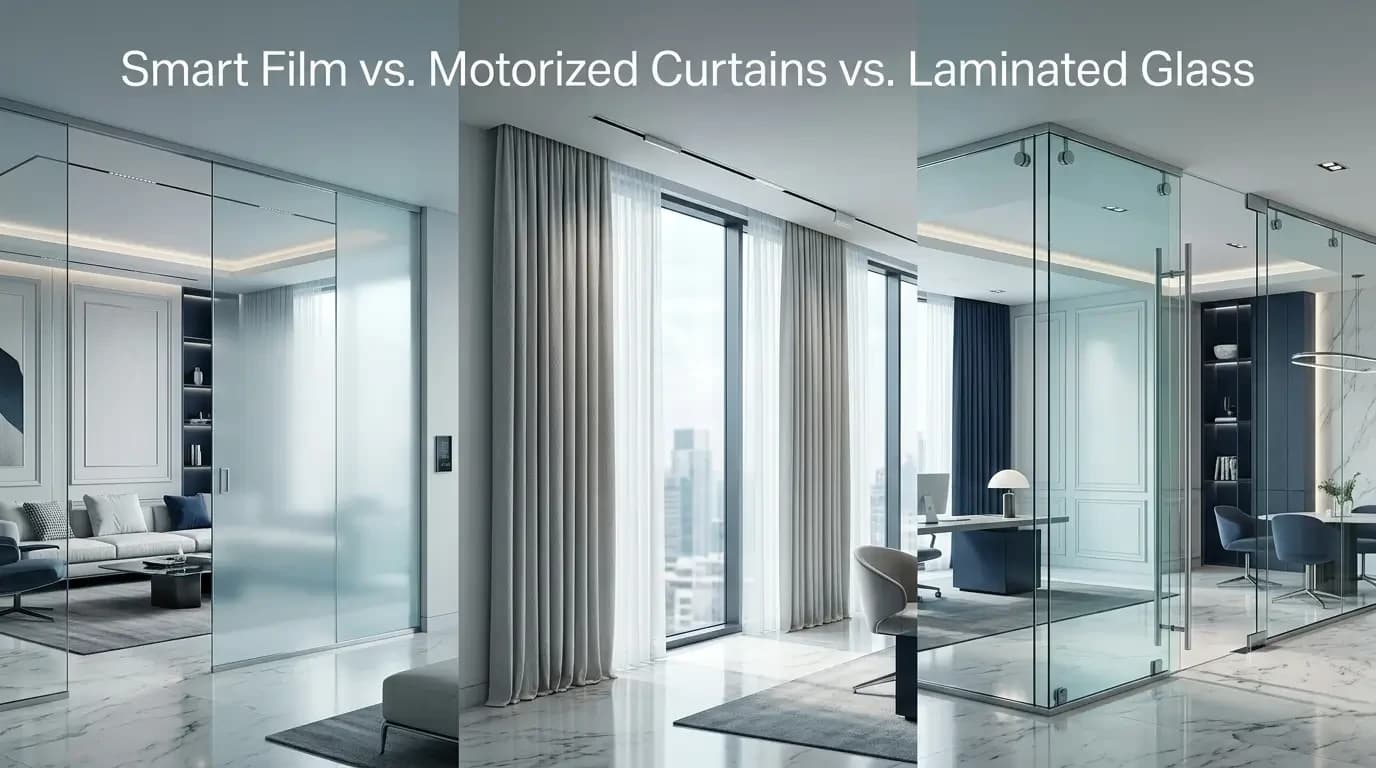
As smart homes and intelligent commercial buildings continue to evolve, controlling privacy and natural lighting has become an essential part of designing homes, offices, clinics, hotels, and meeting rooms. Among today's most popular solutions are Smart Film, motorized curtains, and laminated glass. But one question remains: Which option offers the best investment in 2026?
The answer depends on your specific needs. Whether you're looking for instant privacy, a modern aesthetic, improved energy efficiency, or seamless smart home integration, each solution offers unique advantages. However, thanks to its flexibility and ease of installation, Smart Film has become one of the leading choices for both residential and commercial projects.
This guide compares Smart Film with motorized curtains and laminated glass to help you determine which solution delivers the best long-term value.
Why Has Smart Film Become So Popular in 2026?
Smart Film is an electronically controlled transparent film applied directly to glass surfaces. With the touch of a button, a smartphone app, or a smart home system, it instantly switches from clear to opaque.
Its growing popularity is driven by several key advantages:
Instant privacy without traditional curtains.
A clean, modern architectural appearance.
Convenient remote control operation.
Reduced solar heat and glare.
Natural daylight while maintaining privacy.
Installation on existing glass without replacement.
These benefits have made Smart Film a preferred solution for offices, medical clinics, conference rooms, luxury villas, hotels, and other modern spaces.
Smart Film vs. Motorized Curtains
Although both Smart Film and motorized curtains provide privacy, they differ significantly in functionality, appearance, and long-term performance.
Privacy
Motorized curtains achieve privacy by physically covering the window. Smart Film transforms the glass itself into an opaque surface, preserving the clean architectural design without adding fabrics or bulky hardware.
Design
Smart Film offers a sleek, minimalist appearance. Since there are no curtain boxes, rails, or hanging fabrics, it complements contemporary interior designs more effectively.
Maintenance
Motorized curtains require regular cleaning and occasional maintenance of fabrics, tracks, and motors. Smart Film requires minimal maintenance, with standard glass cleaning being sufficient.
Space Efficiency
Smart Film occupies no additional space, while motorized curtains require room for tracks and movement.
Smart Home Integration
Both systems can integrate with smart home platforms. However, Smart Film provides faster switching and greater convenience, especially in environments where privacy needs change frequently throughout the day.
If your priority is a modern appearance with minimal maintenance, Smart Film is typically the better option. Motorized curtains remain suitable for those seeking greater control over light levels or a decorative window treatment.
Smart Film vs. Laminated Glass
Many people confuse Smart Film with laminated glass, although they serve entirely different purposes.
What Is Laminated Glass?
Laminated glass consists of two or more layers of glass bonded together with a durable plastic interlayer. Its primary purpose is safety and security, as it remains intact even after impact or breakage.
What Is Smart Film?
Smart Film is an electronic privacy solution designed to control glass transparency. It can be installed directly onto existing glass without replacing the glazing.
Which One Is Right for You?
If your main priority is:
Enhanced security and impact resistance, laminated glass is the better choice.
Instant privacy and light control, Smart Film is the ideal solution.
Both security and privacy, Smart Film can be installed on laminated glass to provide the benefits of both technologies.
Which Option Is More Energy Efficient?
One of Smart Film's greatest advantages is its contribution to building energy efficiency.
When switched to its opaque state, Smart Film reduces solar heat gain, helping lower indoor temperatures and decreasing reliance on air conditioning during warmer months.
Motorized curtains also block sunlight, but they eliminate natural daylight whenever they are closed.
Laminated glass alone has limited thermal control unless it includes specialized low-emissivity (Low-E) or solar-control coatings.
Smart Film Cost Compared with Motorized Curtains and Laminated Glass
Project costs vary depending on glass type, installation area, and technology specifications. However, evaluating the investment should go beyond the initial purchase price.
Important factors include:
Expected service life.
Maintenance costs.
Energy savings.
Ease of installation.
Future upgrade potential.
Added property value.
Although Smart Film may cost more than some conventional curtain systems, it offers greater long-term value through reduced maintenance, improved energy efficiency, and a premium architectural appearance.
Best Applications for Smart Film in 2026
Smart Film is increasingly being used across a wide range of industries, including:
Smart homes and luxury villas.
Corporate offices.
Meeting and conference rooms.
Hospitals and medical clinics.
Hotels and resorts.
Banks.
Retail showrooms.
Airports.
Universities and educational institutions.
It is particularly effective for interior glass partitions where spaces frequently alternate between openness and privacy.
How to Choose the Right Solution
Before making your investment, consider the following questions:
Do I need instant privacy?
Is maintaining a modern design important?
Do I want to reduce energy consumption?
Is security or privacy my top priority?
Will I integrate the system into a smart home platform?
What is my project budget?
Answering these questions will help determine which technology best suits both your current and future needs.
Is Smart Film Worth the Investment in 2026?
With the rapid growth of smart building technologies and increasing demand for energy-efficient solutions, Smart Film is one of the most valuable investments available in 2026.
It combines privacy, elegant design, intelligent control, and installation flexibility without requiring replacement of existing glass, making it both practical and cost-effective over the long term.
in the end There is no universal answer when comparing Smart Film, motorized curtains, and laminated glass, as each solution serves different purposes.
If maximum security is your primary concern, laminated glass is the best option. If decorative window coverings and adjustable shading are more important, motorized curtains may be the right choice.
However, if you're looking for instant privacy, modern aesthetics, easy operation, smart home compatibility, and long-term value, Smart Film stands out as one of the best investments for both residential and commercial properties in 2026.
Frequently Asked Questions
Is Smart Film better than motorized curtains?
It depends on your priorities. If you want instant privacy, a modern appearance, and smart home integration, Smart Film is the better option. If decorative styling and complete light blocking are more important, motorized curtains may be more suitable.
What is the difference between Smart Film and laminated glass?
Smart Film electronically changes the transparency of glass to provide instant privacy, while laminated glass is designed primarily for safety, security, and impact resistance. The two technologies can also be combined.
Can Smart Film be installed on existing glass?
Yes. In most cases, Smart Film can be applied directly to existing glass without replacement, making installation faster and more cost-effective.
Does Smart Film reduce electricity consumption?
Yes. By reducing solar heat entering the building, Smart Film helps decrease cooling requirements and improves overall energy efficiency, particularly in buildings with large glass facades.
Does Smart Film require regular maintenance?
Smart Film requires very little maintenance. Routine glass cleaning is generally sufficient, along with occasional inspection of the electrical connections.
What is the lifespan of Smart Film?
The lifespan depends on product quality and installation standards. High-quality Smart Film systems can operate efficiently for many years when professionally installed and properly maintained.
Can Smart Film be controlled remotely?
Yes. Smart Film can be operated using wall switches, remote controls, smartphone applications, or integrated with smart home platforms such as Alexa, Google Home, and centralized building management systems.
Is Smart Film only suitable for homes?
No. Smart Film is widely used in offices, meeting rooms, hospitals, clinics, hotels, banks, airports, educational institutions, retail spaces, and many other commercial environments requiring flexible privacy solutions.
Is Smart Film worth investing in for 2026?
If you're looking for a solution that combines privacy, contemporary design, energy efficiency, and intelligent control, Smart Film is one of the smartest long-term investments for 2026, especially as smart building technologies continue to expand worldwide.