
Smart homes have become an essential part of modern living, offering greater comfort, convenience, security, and automation. Among the most innovative technologies transforming residential and commercial spaces is Smart Film, a solution that allows users to instantly switch glass surfaces from transparent to opaque for privacy and light control.
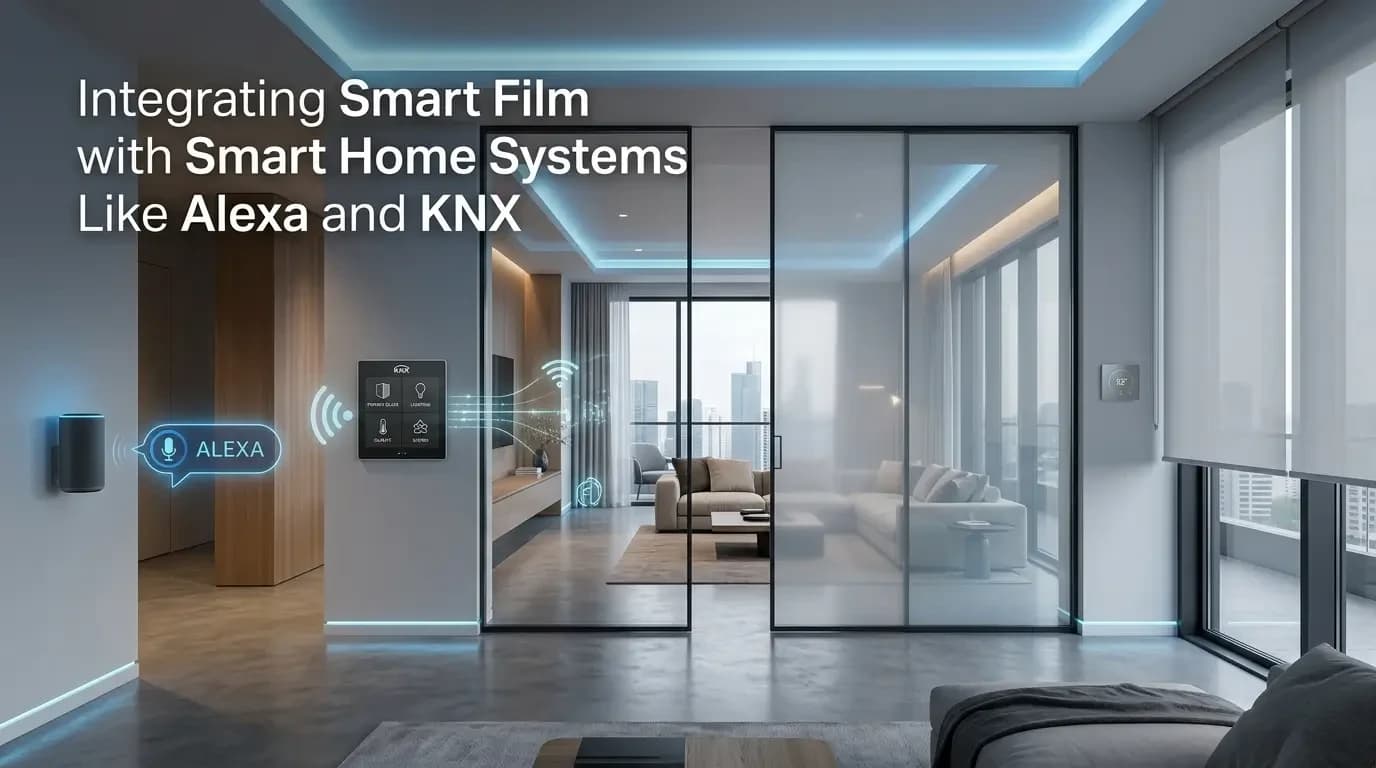
With the advancement of home automation technologies, smart film can now be integrated with voice assistants such as Alexa and advanced building automation platforms like KNX. This integration enables seamless control of glass partitions, windows, and meeting room walls through mobile applications, automation scenarios, or voice commands.
What Is Smart Film and How Does It Work?
Smart film is an electronically controlled layer applied to existing glass surfaces. Using PDLC (Polymer Dispersed Liquid Crystal) technology, the film changes its appearance when electricity is applied. When powered on, the glass becomes transparent. When powered off, it turns opaque, providing instant privacy.
Smart film is widely used in:
Smart homes and luxury villas
Office meeting rooms
Hospitals and healthcare facilities
Hotels and hospitality projects
Commercial showrooms and retail spaces
Its compatibility with modern automation systems makes it an ideal solution for intelligent buildings.
Integrating smart film with a smart home system allows users to automate privacy control as part of their daily routines.
For example, homeowners can create automation scenarios that:
Make glass transparent during daylight hours
Switch glass to privacy mode after sunset
Synchronize with smart lighting systems
Operate through smartphone applications
Activate automatically during movie mode or meeting mode
This level of automation enhances convenience while creating a more intelligent and responsive living environment.
Voice Control for Smart Glass
One of the most attractive features of modern automation is the ability to control smart glass using voice commands through platforms such as Amazon Alexa and Google Assistant.
Instead of manually operating switches, users can simply say:
Make the glass transparent
Activate privacy mode
Turn on meeting room mode
Enable night scene
When integrated with Alexa, smart film responds instantly to voice commands, delivering a hands-free experience that improves comfort and efficiency.
This functionality is particularly useful in luxury homes, executive offices, conference rooms, and smart commercial spaces.
Benefits of Integrating Smart Film with Automation Systems
Combining smart film with smart home technologies provides several advantages.
Enhanced Privacy
Users can instantly switch between transparent and opaque modes without relying on curtains or blinds.
Improved User Experience
Control through smartphones, touch panels, and voice assistants creates a seamless experience.
Increased Property Value
Modern smart technologies add a premium appeal to residential and commercial properties.
Cleaner Interior Design
Smart film eliminates the need for bulky window coverings while maintaining a sleek and contemporary appearance.
Integration with Other Systems
Smart film can work alongside lighting, HVAC systems, motorized curtains, and security devices within a unified platform.
KNX Systems in Saudi Arabia and Smart Film Integration
KNX is one of the most widely adopted building automation standards in Saudi Arabia, particularly in luxury villas, commercial buildings, hotels, and high-end residential projects.
A KNX system can manage:
Lighting control
HVAC systems
Motorized curtains
Security and surveillance systems
Energy management
Smart film and smart glass solutions
When smart film is connected to KNX, users can create advanced automation scenarios. For example, activating a meeting room scene can automatically:
Switch the glass to opaque mode
Dim the lights
Turn on presentation screens
Adjust room temperature
All actions can be triggered with a single command or scheduled automatically.
Why Saudi Homeowners Prefer Smart Film with KNX
Saudi Arabia's growing smart home market has increased demand for integrated automation solutions.
Property owners choose smart film combined with KNX because of:
Centralized Control
All smart systems can be managed through one interface.
Scalability
Additional smart devices can be added in the future without major modifications.
Reliability
KNX is known worldwide for its stability and long-term performance.
Energy Efficiency
Integration with sensors helps optimize lighting conditions and reduce energy consumption.
Modern Aesthetics
Smart film supports contemporary architectural designs and luxury interiors.
Applications of Smart Film in Smart Homes
Smart film is increasingly used in different areas of modern homes.
Living Rooms
Maintains privacy while preserving natural light.
Bedrooms
Creates a comfortable and relaxing environment.
Bathrooms
Provides instant privacy without the need for frosted glass.
Home Offices
Offers flexible privacy for remote work environments.
Entertainment Rooms
Works seamlessly with home cinema systems for enhanced viewing experiences.
The Future of Smart Glass Control
As smart building technologies continue to evolve, smart glass solutions are becoming more intelligent and automated.
Future systems may automatically adjust glass transparency based on:
Sunlight intensity
Occupancy levels
User preferences
Time of day
The integration of smart film with voice assistants, IoT platforms, and building management systems will continue to improve convenience, privacy, and energy efficiency.
in the end Integrating smart film with smart home systems such as Alexa and KNX is a powerful way to enhance privacy, comfort, and automation. By connecting smart film to a smart home ecosystem, users can control glass surfaces through mobile devices, automation scenarios, or voice commands. With the growing adoption of KNX systems in Saudi Arabia, smart film has become an essential component of modern intelligent buildings, delivering a sophisticated user experience while increasing property value and functionality.
Frequently Asked Questions (FAQ)
Can Smart Film Be Connected to Alexa?
Yes. Smart film can be integrated with Amazon Alexa through compatible smart home controllers, allowing users to control glass transparency using voice commands.
Does Smart Film Support KNX Systems?
Yes. Smart film can be integrated with KNX automation systems, enabling centralized control and advanced automation scenarios.
How Can Smart Glass Be Controlled?
Smart glass can be controlled through wall switches, mobile applications, touch panels, automation systems, and voice assistants such as Alexa and Google Assistant.
What Are the Benefits of Connecting Smart Film to a Smart Home?
Benefits include improved privacy, remote control capabilities, automation scheduling, voice control, and integration with lighting, HVAC, and security systems.
Can Smart Film Operate Automatically Based on a Schedule?
Yes. Smart film can be programmed to switch modes automatically according to predefined schedules, sunrise and sunset times, or specific automation events.
Is Smart Film Suitable for Villas and Homes in Saudi Arabia?
Absolutely. Smart film is widely used in luxury villas and modern homes across Saudi Arabia, especially when integrated with KNX and smart home systems.
Does Smart Film Consume a Lot of Electricity?
No. Smart film requires relatively low power consumption during operation and is considered an energy-efficient privacy solution.
Can Smart Film Be Integrated with Google Home?
Yes. Smart film can be connected to Google Home and other smart home ecosystems depending on the controller and integration method used.
Can Multiple Glass Panels Be Controlled Simultaneously?
Yes. Automation platforms such as KNX allow users to control multiple glass panels or rooms individually or as part of a single scene.
What Is the Difference Between Manual and Smart Control?
Manual control relies on a physical switch, while smart control provides advanced options such as voice commands, remote access, automation schedules, and integration with other smart devices.