

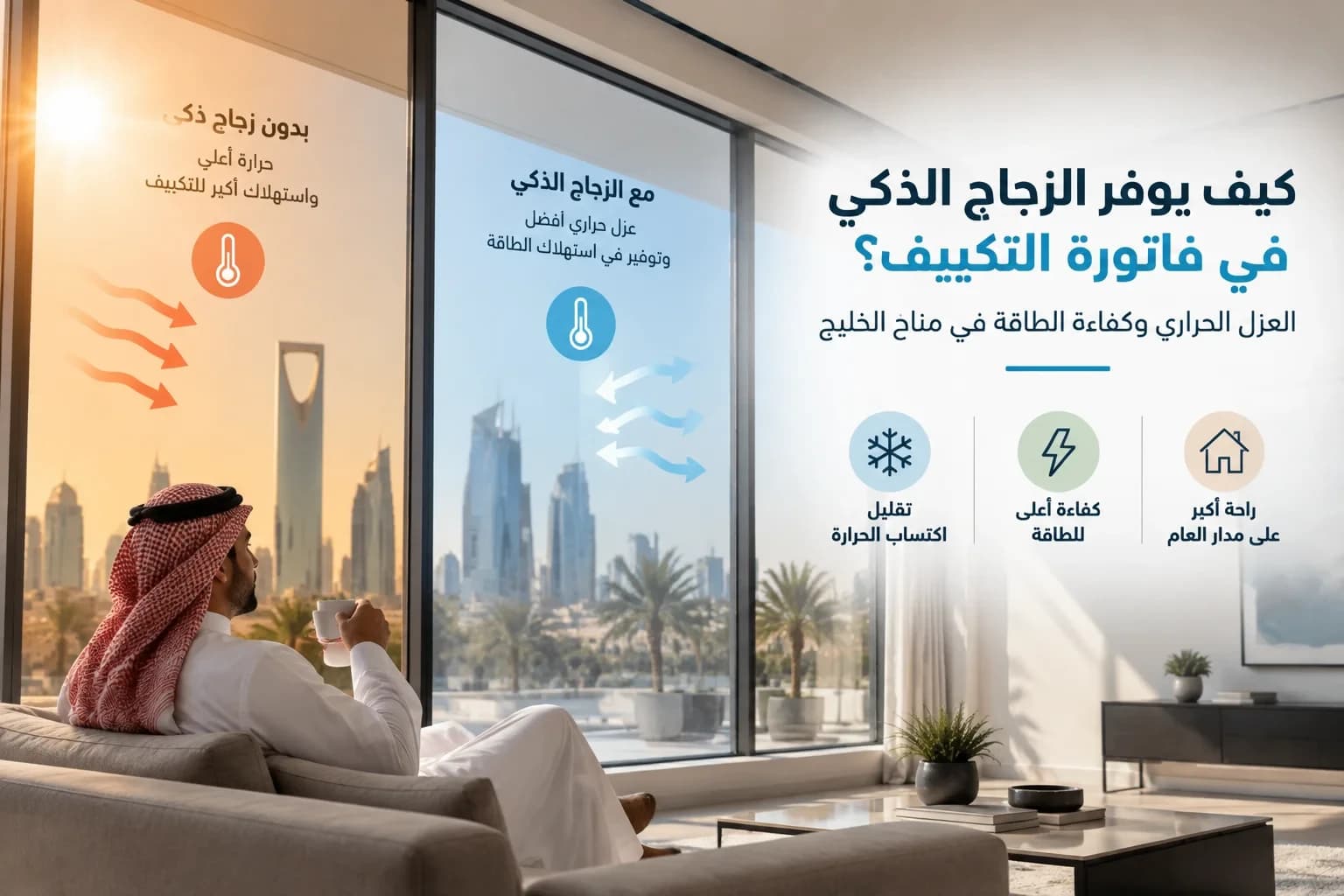
With temperatures rising across the Gulf region, air conditioning operating costs have become one of the biggest challenges facing homeowners and commercial building owners. Windows and glass are among the elements that directly affect the amount of heat entering a building, increasing the cooling load on air conditioning systems and raising electricity consumption.
This is where smart glass comes in as a modern solution that helps improve building performance by controlling the amount of light and heat entering indoor spaces. This technology relies on advanced properties that help reduce the impact of sunlight and improve thermal comfort, contributing to greater energy efficiency, especially in hot climates such as those found across the Gulf countries. Specialized studies indicate that smart glass technologies can help reduce energy consumption and improve thermal comfort in buildings with glass facades.
How Does Smart Glass Affect Air Conditioning Consumption in the Gulf Climate?
Air conditioning costs are heavily influenced by the amount of heat transferred from outside to inside, particularly during the summer months when temperatures rise significantly. Traditional glass allows a large amount of solar radiation to enter, increasing room temperatures and causing air conditioning systems to operate for longer periods.
Smart glass helps control heat transfer by changing its optical properties. It can reduce the amount of solar radiation reaching indoor spaces while maintaining natural light. This control reduces the load on cooling systems and helps keep indoor temperatures more stable.
Some of the key factors that make smart glass suitable for the Gulf climate include:
Reducing heat gain caused by solar radiation.
Improving thermal comfort inside the building.
Reducing continuous reliance on air conditioning systems.
Contributing to greater electricity efficiency.
Thermal Insulation with Smart Glass and Its Role in Maintaining Building Temperature
Thermal insulation with smart glass is one of the modern solutions used to improve the performance of glass facades. It helps reduce heat transfer between the outdoor and indoor environments. When less heat enters a building, air conditioning systems can reach the desired temperature while consuming less energy.
How Does Smart Glass Reduce Heat Transfer from Outside to Inside?
Smart glass works through different technologies, such as electrochromic glass or PDLC Films, which control the passage of light and heat. In the case of SmartVue, the solution relies on PDLC Film technology, which changes glass from transparent to opaque at the press of a button, with properties that help reduce the impact of ultraviolet radiation and solar heat.
This makes indoor spaces more comfortable, particularly in buildings with large glass surfaces such as offices, villas, and hotels. Controlling the amount of light also helps reduce solar glare and improve the working environment.
Smart Glass Energy Savings: Does It Really Help Reduce Electricity Bills?
Smart glass energy savings are one of the main reasons many building owners choose this technology, particularly in areas that rely heavily on air conditioning. When the amount of heat entering through windows is reduced, the cooling load required to maintain a comfortable indoor temperature also decreases.
Reducing Air Conditioning Operation During Peak Hours
During the daytime, sunlight reaches its highest intensity, causing indoor temperatures to rise. Using smart glass helps reduce this effect by controlling the transmission of light and solar energy.
Benefits include:
Reducing air conditioning operating time.
Improving temperature distribution throughout rooms.
Reducing electricity consumption over the long term.
Supporting energy efficiency goals in modern buildings.
Research on smart glass in hot climates indicates that advanced glazing systems can contribute to reducing cooling loads compared with traditional glass.
How Does Smart Glass Reduce Solar Heat?
The problem of excessive heat caused by sunlight is one of the biggest challenges in glass buildings, particularly in the Gulf region. Smart glass solutions therefore rely on technologies that help control the amount of solar energy reaching indoor spaces.
Controlling Ultraviolet Radiation and Solar Heat
The role of smart glass is not limited to providing privacy. It can also help reduce the impact of ultraviolet radiation and solar heat. SmartVue solutions feature Smart Privacy Film that can block ultraviolet radiation and reduce solar heat, supporting improved building efficiency.
Reducing solar radiation can also help protect furniture and interior décor from damage caused by prolonged sun exposure, while maintaining a modern design without relying entirely on traditional curtains.
Thermal Insulating Glass or Smart Glass? What Is the Difference?
Both thermal insulating glass and smart glass aim to improve building performance, but they differ in how they work. Thermal insulating glass typically relies on special layers or treatments that reduce heat transfer, while smart glass adds the ability to control the level of transparency or the amount of light according to the need.
Smart glass combines several functions:
Privacy control.
Reducing heat entering the building.
Improving natural lighting.
Adding aesthetic value to the space.
Traditional thermal insulating glass may be suitable for reducing heat transfer, but it does not provide the same level of dynamic control offered by smart glass technologies.
The Role of Smart Glass in Improving Energy Efficiency in Saudi Buildings
Saudi building energy efficiency has become an important goal with the expansion of modern projects and increased reliance on glass-based designs. Choosing advanced glazing solutions can help reduce energy consumption and improve building performance throughout the year.
Smart Glass Applications in Villas, Offices, and Hotels
Smart glass can be used across a wide range of sectors, including:
Offices and meeting rooms.
Villas and luxury homes.
Hotels and resorts.
Clinics and commercial facilities.
SmartVue provides Smart Film solutions for offices, villas, clinics, hotels, and other sectors across Saudi Arabia.
Benefits of Using Smart Glass in Gulf Buildings
Choosing smart glass offers several benefits that suit the characteristics of the Gulf climate, including:
Reducing solar heat entering the building.
Improving comfort inside indoor spaces.
Reducing air conditioning-related energy consumption.
Providing instant privacy when needed.
Maintaining a modern architectural design.
Solutions such as Smart Film also do not always require replacing the existing glass, as Smart Film can be applied to existing glass surfaces depending on the project requirements.
Get the Right Smart Glass Solution for Your Building with SmartVue
If you are looking for a practical way to improve building efficiency and reduce the impact of solar heat, choosing the right smart glass system can help you achieve a balance between modern design and energy efficiency.
SmartVue provides Smart Privacy Film and PDLC Film solutions in Saudi Arabia for homes, offices, and commercial projects, along with professional site assessment and installation services.
Start developing a more comfortable and efficient space by choosing the solution that meets your building's needs.
Frequently Asked Questions About Smart Glass and Energy Savings
Does Smart Glass Reduce Electricity Bills?
Yes, smart glass can help reduce electricity consumption by limiting the amount of heat and solar radiation entering a building, which reduces the load on air conditioning systems.
Is Smart Glass Considered Thermal Insulating Glass?
Smart glass can help improve thermal insulation and control heat transfer, but it differs from traditional types of insulating glass in terms of how it works and the additional functions it provides.
How Much Energy Does Smart Glass Save?
The amount of energy saved varies depending on the type of glass, window area, building location, and air conditioning system used. Therefore, results are determined based on the specific project.
Can Smart Glass Be Installed on Existing Glass?
Yes, some Smart Film solutions, such as PDLC Film, can be installed on existing glass without the need to replace it completely.
Is Smart Glass Suitable for Saudi Arabia's Hot Climate?
Yes, it is suitable for areas with high temperatures because it helps control light, reduce the impact of solar heat, and improve building efficiency.